Showing posts with label Heirloom Tomatoes. Show all posts

Sunday, August 18, 2024

The Most Interesting Tomato Plant of the Month! AUGUST 2024 Edition!

The Most Interesting Man in the World
If the collective voices of the gardening world that is on Facebook are to be believed, many backyard growers are not having the best of gardening seasons, In fact, some are reporting epic failures. If the heatwave that struck California in late June and continued through most of July wasn't bad enough, gardeners have been forced to do battle against hordes of rats intent on stealing every last bit of delectable summer garden goodness.

If this describes your gardening experience this summer, my most sincere apologies. Trust me, I've been there. I remember one summer with ZERO production from eight plants that I had placed into one of the first raised gardening beds that I would build. If I wanted a tomato that year I had to buy it from someone else. Then came the rat raids that decimated past gardening efforts. If I am describing your experience this year, I have these words of advice: Don't give up. Try, try again. You have learned much, young padawan. Apply these harsh lessons to next year's effort, and the year after, and the year after that.

Pink Ping Pong Tomatoes
In time you will begin to apply these harsh lessons into growing vegetable gardens that you never dreamed possible. It doesn't happen overnight. But if you keep at it long enough, as I have, it does happen. Case in point? The Most Interesting Tomato Plant of the Month -- which happens to be the month of August, 2024. The most interesting plant also happens to be one of the most productive. But, I will also warn you that this isn't one of the easiest varieties to grow. In fact, I've experienced more misses and flops with the tomato plant to the left than I've had hits.

So, why grow it if it's so unreliable? Because I enjoy garden failures? No, not really. It's the challenge, I suppose. I also recall the one good year I've had with this variety, which was most excellent and a massive stroke of luck. I handed out bags of cherry tomatoes to all of my friends at work that year, and it's this one that many of them cited as their most favorite in the collection. It is called Pink Ping Pong. It is the most interesting tomato plant for the month of August in my Citrus Heights garden. It also happens to be the most productive at the moment and may continue to hold onto that lofty spot through September (although there will be other challengers).

Pink Ping Pong Plant
Pink Ping Pong is an heirloom tomato variety. What is an heirloom? Heirloom = OLD. Unfortunately, there isn't a whole lot of information regarding exactly where it came from or how it came to be. The story, related by several growers, is that the seeds for this variety were first collected by Andrew Rahart. Yes, this is the same Andrew Rahart who was also responsible for the tomato plant variety known as Andrew Rahart's Jumbo Red. Which is also another heirloom. Rahart lived in upper New York state as the story goes and collected seeds from tomatoes that he considered to be unusual. Long before the age of the World Wide Web, he would farm these seeds out to others via snail mail. That is how Pink Ping Pong really caught on.

The variety caught the attention of another famous grower in New Jersey. Dr. Carolyn Male was so impressed with this tomato that she included it in her heirloom tomato bible, a must-have book for any tomato plant afficiando: 100-Heirloom Tomatoes for the American Garden. If you do not have a copy of this book, get one. You will not regret it. Carolyn, unfortunately, passed some years ago. But her experience lives on. Understand that there are literally THOUSANDS of heirloom tomato varieties. Carolyn tested many of them. She had the farm acreage to do it. So, getting on her "Top 100" list is quite the accomplishment.

Pink Ping Pong Production
"Pink Ping Pong is aptly named,"
she writes. "It's about the size of a ping pong ball and has a soft pink color. The taste is very sweet, smooth and juicy. I don't grow cherry tomatoes for taste alone. They are fantastic for salads and snacking."

My Pink Ping Pong effort this year was the product of a seed starting effort in a spare bedroom. Seeds were planted in a red solo cup and got enough winter sunshine through a closed window to germinate. Like any tomato plant started in this way, the seeds that sprouted grew quite leggy and weak, a development was not rectified until the hardening off process started in earnest this past spring. Although I had better starter plants to choose from (a tomato growing friend gets great results from his greenhouse), I kept the leggy starter plant that I grew and farmed out the leftover Pink Ping Pong plants to other gardeners.

It anchors "Cherry Row." This is a row of five cherry tomato varieties that include Super Sweet 100, Sun Sugar and Sugar Lump, among others. Although it got off to a slower start than the other, stronger cherry varieties, it soon caught up. My Pink Ping Pong is now over six feet tall, handled our famous heatwave this summer like most heirlooms do, and set a fabulous crop.

Cherry Tomato Plant Row
The biggest harvest from this one plant, which came approximately two weeks ago, resulted in 20 vine-ripened Pink Ping Pong fruits. Which I promptly bagged up and handed off to various neighbors. But not before I snacked on three or four of them. I look forward to the next harvest of 20 or more, and the one after that. I don't care how hot it gets around here. Blistering temperatures do not shut down productive heirloom tomato plants. Ever. That's why people grow them.

This is the best Pink Ping Pong plant I've managed to grow since a volunteer plant sprouted out of an old North Natomas clay-muck soil garden and set a surprise crop of delicious tomatoes. That was many moons ago. But I have not forgotten that experience. Oddly enough, this "volunteer" sprang from a massive failure of an experience the previous summer. I think that plant grew all of three tomatoes. One of which obviously hit the ground and managed to drop a few seeds. The plants that sprouted from that gardening failure turned out to be some of the best and most productive that I ever grew.

Dumb luck? Maybe. It does happen in the garden. But it also results in an experience that you work to create again and again. Because, it's just that good.

Grow tomatoes, my friends. The payoff from efforts like Cherry Row is well worth the effort.

Friday, July 26, 2024

EMERGENCY!

Garden Bonanza!
A real emergency? No, not really. A bit of an overreaction on my part? Possibly. But, to be honest, I was worried. I still am worried. I have good reason to be worried about the state of the 2024 vegetable garden. It is turning out to be one of the most successful gardens I have ever planted, either directly in the ground or in a series of raised gardening beds.

The picture to your right is just one example of what is taking place in this year's garden. I started harvesting a month ago. A tomato here and a tomato there turned into two or three fairly quickly. Add that to a Sumter cucumber or two harvested from the cucumber patch, and that's a right fine salad for dinner, lunch or both.

But it didn't stay that way for long. Two to three ripe tomatoes per day turned into dozens very quickly when the five plants that I designated as Cherry Row began to produce. Combine that with the heirloom and hybrid tomato varieties that had started to show signs of turning a pleasing shade of pink, red, or yellow and things began to get interesting to say the least. But, I wasn't worried. Not yet.

Cherry Tomato Plant Row
That all changed one week ago. That is when I spotted trouble. The first sign of trouble. A pest known as a rat, or perhaps several, had discovered the ripe tomatoes waiting to be harvested at the base of a Better Boy tomato plant. This one rat, or many members of his or her family, had managed to eat a large chunk out of one very red and very ripe tomato, and had also started in on another ripe offering just behind it.

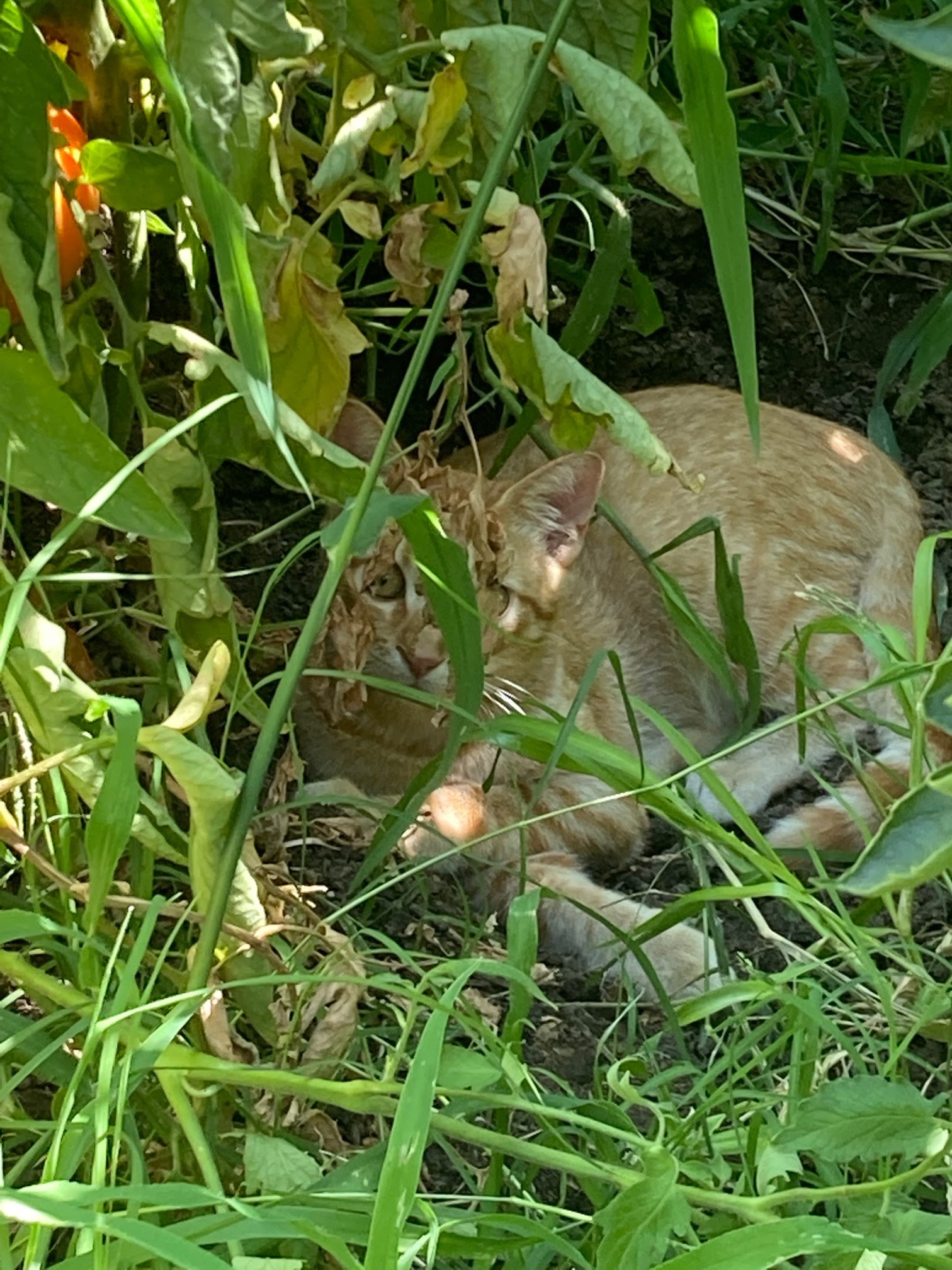
It has been some years since I spotted any kind of rat or critter damage in the garden. So, I was somewhat surprised to see this kind of critter trouble suddenly resurface. The adoption of a rescue cat from the Sacramento County Bradshaw Animal Shelter put an end to never-ending rat raids that destroyed vegetable gardening efforts of the past. The kids who live next door, and who also love home-grown garden produce, christened my new orange striped rescue with the name of Mango.

Mango Kitten: 2021
That was three years ago. Mango immediately sprung into action the moment I introduced him to the backyard garden in May of 2021. This five-week old ball of fluff immediately owned every row of garden, as well as the fruit trees planted nearby. The rat and critter raids that had decimated the gardens of the past came to an immediate end. Mango caught his fair share of rats, but in reality he scared most of the garden predators out of the yard. Possums and skunks still made an appearance every now and then, but Mango formed a kinship with both. As long as they stayed out of the garden and the fruit trees, all were welcome in Mango's backyard. It was interesting to see those relationships grow and develop.

Unfortunately, Mango developed a bit of a limp last winter. Although it was unrelated to his rat hunting escapades in the garden, it still worried me a bit. Yes, Mango received veterinary care. But, I passed when the veterinarian proposed a surgical solution that carried a cost comparable to the purchase of a new car. There are reasons why I passed. I suppose the biggest reason was that the proposed solution was largely experimental. There was a chance it would not have worked. There was also a slight chance that it would have resulted in a permanent reduction in Mango's ability to walk, let alone run.

Mango on Garden Patrol
Given time, and the onset of summer weather, I had a strong suspicion that Mango's limp would improve with time and rest. It was a correct assumption. Mango's limp vanished as the weather turned from winter to spring. It wasn't long before my rat hunter was springing over fences again and charging after unfortunate dogs who dared to walk in front of his home. All was soon right in Mango's world again. If you don't believe me, just ask the poor German Shepherd that dared to lift his leg on the corner of some inviting grass in the front yard. Mango plays with all dogs who choose to visit. Or launches a surprise attack from beneath a bush or car.

The recent discovery of serious rat damage in the garden, however, surprised me a great deal. No rat had dared to visit since Mango started his daily patrols as a small kitten. It did not take long before that recent discovery of rat damage led to another distressing sight. Mango showed up a moment later, limping badly on the same back leg that troubled him a great deal last winter. I knew immediately that Mango had done battle with a large rat or several rats, and those garden raiders had managed to get the better of him. Or, that was the initial belief. It's been a week since that discovery, and the rat or rats have not returned. There have been no further raids on the garden. Mango's limp, meanwhile, has improved somewhat dramatically.

Mystery Potato Leaf Heirloom
This did not stop me from stripping the garden of every last ripe tomato on the vine. I was not going to wait and risk further rat raids that would have laid waste to garden growth efforts. This was a very early harvest compared to years past. I normally have to wait until late August to see this kind of production out of the garden. This year, however, is proving to be one of those special production years. It might be the record heat that has hammered Northern California this summer. It could also be some changes I adopted in providing water to each tomato plant. It might have been some changes that I adopted when I prepared the garden area for spring planting. Or, I suppose, it just could be one of those years. I'm not sure.

I can only tell you that prime tomato production season has arrived early this year. Every plant in the garden, from hybrids to heirlooms, is sporting a fantastic early crop and enough green tomatoes to guarantee a fantastic late crop. Most of the late production is springing from the heirloom varieties like Caspian Pink, Pruden's Purple, Black from Tula and Watermelon Beefsteak to name a few. This is completely normal. Heirloom varieties are known to deliver bountiful crops both early and late.

Brewing Tomato Sauce
Hybrids are a bit different in respects to production. Those time honored favorites like Better Boy, Better Boy Plus, Big Beef Plus and Steak Sandwich Hybrid tend to produce one big crop. They tend to ripen at the same time and ripen earlier in the season than heirlooms. Which works for me. It makes for a nice garden mix. A sink full of red, pink, black and yellow colors is a pleasing sight to behold. It also means a lot of work!

As for the rats that made an unwelcome visit one night and took chunks out of two big Better Boy tomatoes, they have not returned. This is surprising because rats are very smart creatures. Once they discover a food source they normally make a return appearance. But, they have not returned. I'm fairly certain that it is due to Mango's patrol efforts. He has not provided me with any garden gifts just yet. Which is fine by me. As long as he keeps the raiders out, I'm fine with it. The rats have not returned to the garden, nor have they attempted to raid the black fig tree nearby. This is another welcome development.

Heirloom Tomato Sauce
My recent "EMERGENCY" harvest moment resulted in enough tomatoes, sweet bell peppers, hot 
jalapeño and paprika peppers, onions and basil to create 15-pints and five quarts of thick garden-grown tomato sauce. It has also resulted in multiple cherry tomato deliveries to the five children who live next door. They can't get enough of them. That kind of appreciative audience works for me. I hope you experience the same type of blessing.

EDIT: I am always listening to the advice of other long-time gardeners. Many are suffering from raids by rats or other wildlife this season. Rats are showing up in backyards where they have never paid a visit before. There are some gardeners who suggest that these raiders are, in reality, stressed by our extraordinary heat this summer combined with a lack of water. They have suggested bowls of water placed strategically outside of garden areas. This sounds like good advice to me.

Tuesday, May 21, 2024

Planting Party!

Garden Cat Mango on Patrol
The warm spring temperatures have finally arrived. The wet winter weather is finally behind us. The soil is now prepared is ready. It's time to plant the 2024 Summer Garden!

This is the start of a summer season that means overwhelming abundance in terms of bright and tasy heirloom tomatoes, the crisp crunch of heirloom variety cucumbers, green and yellow squash sliced lengthwise, drowned in olive oil, seasoned with salt and pepper and browned on a flaming summer grill.

But that's just the start! Yes, there's more! The summer garden also means a wide variety of bush beans, multiple varieties of basil, gigantic sweet bell peppers, an eye-popping assortment of hot peppers like the time honored jalapeno and a vast number of home-canning projects such as tomato sauces, tomato soups, plus tomato and hot pepper salsas.

2024 Summer Garden (Partial)
That doesn't even count the bags of home grown garden goodies that will be be packed up and delivered to neighbors near and far. A summer vegetable garden can provide that and more. It doesn't feed the needs of just one household. It can provide summer sustenance for many. This includes a never-ending supply of sweet, multi-colored cherry tomatoes. Summer gardens are the bomb. Every last morsel that springs forth from that summer soil is 100-percent good for the body and soul.

That's why I love summer gardens. How about you?

Preparing a backyard soil that consists of sticky, heavy clay was the first step. That preparation, outlined in previous posts called The Method Part I and The Method Part II, has created the perfect area for planting efforts. BUT, the job isn't quite done yet. The job leaves you with a large patch of soil that is perfect for planting. But still need to take steps to ensure that every inch of that soil is put to good use.

First Garden Trail
All gardens need access. Cutting yourself off from one side of a productive tomato plant, for example, is no good. A good garden needs narrow trails and lots of them so that every section can be reached in multiple ways. However, the last thing you want to do is create trails out of that great soil that has been created with amendments, rototilling and other garden preparation efforts.

So, my method of madness works in the following way: I create my first of many rows for the garden by laying out a series of markers, In my case? I use pieces of PVC cage parts that I created years ago and continue to put to work in the garden. These cage parts make for perfectly straight garden rows, and also play a role as a planting guide. But the first step is to cut an access trail right next to that first row.

Cutting a six-inch deep access trail next to that first and second row that will hold dozens of tomato plants creates piles of nicely amended soil. Instead of 18-inches of loose soil, each row set aside for growing efforts will have two feet or more. I'm certainly not going to walk all over that nice garden soil that I've taken multiple steps to create. I'm going to move it to where it's needed.

Garden Layout in Progress
Is this extra work? Extra stress on the legs? A workout for a cranky back? You bet it is. But the payoffs are what I like to call "layer cakes" of amended garden soils that will eventually hold starter plants OR rows of seeds. The mounds of really good soil that I will create with my pathway creation efforts still need to be raked level.

The entire garden resembles high and low sections by the time I'm finished. There are narrow access rows and trails cut into every section of the garden. The planting areas receive several extra inches of great soil, and both the dog and cat have trails to run up and down as they scare away rats and other garden thieves throughout the summer months. There's no place for the garden thieves to hide out. They either stay out of the garden, or risk the consquences.

Once this work is done, it's time to start the planting process. I learned many years ago that using a post-hole digging tool that is normally employed for fence posts is the best tool for planting tomatoes. The PVC pieces that I put into place earlier during the trail creation phase also serve as planting guides. The holes for each tomato starter plant are dug in the center of each PVC frame. A month later I will need to remove that frame to actually build the cage that will support monster plants later that summer. But, that job can wait for a little while.

Digging Plant Holes
There was a day and age when I once utilized fish heads and other parts of fish that had been cleaned and thrown away to place at the bottom of those planting holes. But that practice ended a few years for me due to recycling efforts that made this once easily accessible and desired garden amendment very hard to come by. So, the only thing that goes into that two-foot deep hole that I've created with the post-hole digger is the rootball of the tomato plant that I will place there. Everything is then covered with heavily amended soil, and it's time to move to the next hole.

The same system works just as well with the garden pepper starter plants, but the holes for those are not cut nearly as deep. That process moves quite a bit faster because there's not as much soil to cut through. It can take a day or more to dig the 45-50 planting holes I will need for each starter plant, but it saves a lot of bending and stress on the knees.

Cherry Tomato Plant Row
After planting every transplant that the garden will hold, the next step is cutting long rows in the soil layer cake of amended soil for seeds. Long rows are set aside for an heirloom cucumber called Sumter. Additional rows are created for heirloom bush bean plants that carry the time honored names of Blue Lake, Kentucky Wonder and Pencil Pod.

Bush beans grow well here. The Sumter Cucumber, which I discovered by complete accident a few years ago, also grows extremely well in this climate. What doesn't grow well in California? I've really yet to find any garden vegetable that does not flourish in this climate. I suppose it's the reason why I've stayed, while so many of my counterparts have run off to other areas of the country.

So you have it! I'm still working on other sections of the garden. There's always something to do. The garden effort really doesn't end. Because, by the time planting efforts end, it's nearly time to start enjoying the harvest. Then, the period of over-production starts. That's the signal to start providing to others, or multiple canning projects to save chunks of that summer garden for winter use.

As you might imagine, I enjoy this type of work very much.

Friday, May 10, 2024

The Method -- Part II

Garden Plants in Waiting
The Method that I employ to prepare a backyard of clay soil for extensive gardening efforts involves a number of steps. This method, which I developed over a number of years, is pulled from personal gardening experience and an understanding of what works in the garden and what doesn't. This method was also pulled from the experience of watching others and the style that they employed.

I also strongly believe that the method that commercial farmers use is a big recipe for success. Commercial tomato farmers concentrate on one crop and one crop only for the most part: the variety of tomato known as the "processing tomato." Today's processing tomatoes resemble pear-shaped tomato fruit, also known as "roma."

It wasn't always this way. In fact, many heirloom tomatoes grown today once did double duty as processing tomatoes from a different era. Campbell's 1327 comes to mind as an example. This was the variety that was once widely grown for Campbell's famous Tomato Condensed Soups. There are others.

Garden Area
Clearing the garden area of weeds with a lawn mower, weed eater and a normal shovel to dig out the pesky Mallow is the first step in the process. The second step is a "first chop" with the Mantis Rototiller. These steps, which I outlined in a previous blog posting, end with the result of four to six inches of loose soil. It's a good start. But I want more. The third step that I employ will wear a gardener out. It can take hours to achieve the end result. It's a step, however, that helps to achieve the results that I want.

Four to six inches of loose clay soil isn't enough. I want a deeper cut. The only way for me to accomplish this cut is to employ an old fashioned shovel and get to work. The shovel is used to dig up every square inch of garden area. This "cut" into the garden soil brings up big chunks of soft clay soil. Those chunks are turned over. By the time I'm done with this step, the garden soil looks like row after row of large, brown marshmallows. It also results in 12-16 inches of loose garden soil over the entire garden area. Every bit of it, from one side to the other, is lifted up and turned over.

Employing this method also tells me just how healthy my clay soil really is. Garden soil should be alive with living organisms. This includes worms, both large and small. Turning the soil over and breaking up clay chunks with the shovel also allows worms to escape and dig deeper into the soil that I have just dug them out of. Which is exactly what I want them to do. Those big earthworms and many smaller wrigglers are exactly what I want in my garden soil. I don't want to commit the crime of chopping them up with the Mantis.

Chunky Clay "Marshmallows"
I will not lie to you. This step is not easy on the body nor is it quick garden work. It normally takes me three to four hours of pushing, pulling and grunting to accomplish the task. If that shovel does not easily slide into the soil below, I use the power of my feet and legs until it gets to a depth I'm happy with. This is a routine that is employed every time that shovel is placed into the ground. The goal is the deepest cut I can get, without snapping the shovel into pieces when I turn that big, gray dirt clod over. The goal also is not snapping my back into tiny pieces either. I'm not always successful.

This is a gardening method that I learned from a friend who I put to work in my garden one year when my pesky back gave out. He grew up on a small farm in Merdead (Merced) County. I had never witnessed anyone do this before. I never forgot it either. It had never crossed my mind to do something like this. This step is not easy. I must stress this. I run into all sorts of tree roots, rocks and other obstructions with each shovel full of clay that I bring up and turn over. Yet, I do understand that it is work that must be done.

If the clay soil will not give into the efforts of me jumping up and down on a shovel, I will employ a little strategy. That garden area might need a little more water. Again, the goal is a soft, pliable clay that a shovel will slice into, not a mud pit. If 30-minutes with a garden sprinkler and a bit of a wait will accomplish this task, that is the solution that I will employ. Time isn't the issue here. Getting that soil just right is. If this process takes a day, or I have to let the soil sit overnight after watering it, I will. If I need to stop and clip away pesky roots that are the size of small tree branches OR dig out large rocks, I will do that too.

Brain Vibration Tool
Once the garden area resembles one row after another of large, brown marshmallows, it's once again time to fire up the Mantis. This is the fourth step. The Mantis is put to work chopping those big, brown clay chunks into much smaller chunks. The goal is a fine soil, but I normally do not accomplish this goal until the final step of The Method. Fortunately, the fourth step is usually a bit easier than the first chop with the rototiller.

The work still leaves me with a vibrating brain by the time the chopping work is done. Fortunately, it doesn't vibrate for nearly as long. Employing a garden rake to level out the chop and achieve a semi-level garden area also cuts down on the vibration. The fourth step in the process leaves me with anywhere from one to two feet of loose garden soil. I do my level best not to step on it. This is the step that also cuts down upon, but does not eliminate, pesky garden weeds.

The goal I had of one to two feet of loose garden soil has been achieved. But, the work isn't done yet. The next step, which is step five in The Method, is amending the soil. The amendment process is just as important. If I can accomplish this goal now, it means I won't need to fertilize the garden once all summer. It will have all the nutrient matter it needs to keep producing an assortment of vegetables all summer long.

Garden Amendment Gold
It means nightly salads of heirloom tomatoes, slices of mouthwatering cucumbers and fragrant, fresh basil and oregano. The end result also means an entire summer's worth of zucchini and crookneck squash, sliced lengthwise, brushed with olive oil, coated in salt and pepper and cooked on an outdoor grill. The end result is also processed tomato sauces and salsas, both flavored and heated by heaps of garden bell and hot peppers. One small garden can produce a winter of summer delights.

I employ two products in the amendment process: These include bags of steer manure compost and bags of pellet fertilzer from my local big box stores (Home Depot and Lowe's). Both are spread out over the soil as equally as possible before the Mantis is employed one final time.

Adding amendments to the soil however, can be a bit tricky. It is highly possible to add too much of a good thing. The amendments I add will bring three important nutrients to my garden area: Nitrogen, Phosphorus and Potassium. By adding just enough, and not one tablespoon more, you will be rewarded with an enormously productive garden. Adding too much will result in a garden that grows well, but doesn't produce nearly as much as the previous year's garden did.

Amending the Soil
I've come to learn that covering every section of the garden with at least one inch of steer manure compost does the trick. I attempted to double up on that amount one year. Bad idea. Although I always experiment in my garden, this is one experiment that went awry. The goal is to feed your garden plants. Not burn or shock them into non-production.

I do know that there are other gardeners who employ chicken manure in the garden. I'm not one of them. Never had much luck with it. Composted chicken manure is far hotter than its steer manure cousin. If you employ too much of it, which I've done, the result usually isn't something to write home about. So, I stick with the tried and true method.

After stomping on my amended garden soil to spread out anywhere from 25-30 bags of steer manure compost, I also spread out about a bag and a half of pellet fertilizer. I've used many different brands to accomplish this task. I'm not going to recommend one brand over another, but I've had the most luck with the Vigoro brand of Tomato and Vegetable food. I purchase the 3.5 lb. sacks. I spread out about a bag and a half. The remaining half bag will be used to fertilize fruit trees and bushes over the summer months.

The Goal
The final step? Step six is putting the Mantis back to work for a third and final time. The steer manure compost and pellet fertilizer is worked deeply into the soil. This final chop also takes care of the clay dirt clods that didn't quite get broken up with the second chop outlined earlier. The end result, after raking the garden area as level as I can, is a smooth and amended garden soil. The final product will be a pleasing color of rich, dark, and amended clay that crumbles when touched. It is a soil creation that is perfect for what I want because it will keep my garden plants in production all summer long. Which is the goal.

Does this mean I'm ready to start planting? HEAVENS NO! The planting process is also "involved." Not quite as involved as the gardening preparation that I've just outlined, but there is yet another "method" to this gardening madness. That outline will come next. I've got some planting to do!

Toodles!

Sunday, August 27, 2023

The Most Interesting Tomato Plant of the Month! August 2023

Weekend Haul (Partial)
I don't always grow tomato plants. Wait, that's a lie. I've been growing tomato plants every summer for 25-years straight. So, I guess my message to you should be: Grow Tomatoes, My Friends.

The photo to your immediate right? That represents my big weekend activity for the month of August. I'm either collecting ripe tomatoes to make gobs upon gobs of canned tomato sauce (with the bite of Jalapeño peppers I might add), OR I'm throwing them into bags and BEGGING my neighbors to take them.

This is the moment in August where heirloom tomato production is positively off the hook. It's not over yet. There are three times as many green tomatoes on the plants that I harvested from today than those that show the color of absolute peak heirloom ripeness. This means another month, or even two, of heirloom tomato harvests. This is, of course, provided the weather holds out.

Cold nights can screw up an heirloom tomato harvest. The tomatoes still turn a pleasing color of red, pink, yellow, orange or whatever variety you are choosing to grow. But sustained cool temperatures at night can play havoc with that heirloom taste.

Tomato of the Month
The nights, unfortunately, have been getting a bit cooler recently. It's not cold yet. But it's near the end of August, which means cold weather isn't very far off. It hasn't affected the taste yet. Today's serving of the giant pink monsters known as Marianna's Peace (MP) were positively off the hook. But, I do worry.

Although I could easily give the August title to MP, or any one of a number of other heirloom producers, I've saved this singular honor for a new variety that popped up in my garden this year. It's called Bread and Salt. It has been an absolute pleasure to grow and the production has been rather outstanding.

This is not a new variety. Not by any stretch of the imagination. It is somewhat new to the United States. But, in the heart of Mother Russia, this variety is well known. I can only tell you that the seeds for this variety did, in fact, come from Russia. I'm not sure exactly where, since this variety is apparently grown all over the Eastern European continent. I'm not at all surprised.

Bread and Salt
Bread and Salt is what tomato growers call an "oxheart" variety. It is a very large oxheart variety. How big? As big as my big, fat hand. Perhaps even bigger. I was blessed with two Bread and Salt starter plants this year. I gave one away and planted the other. I didn't give it much thought beyond that. I didn't know what to expect out of this variety because it's not one I had been expecting to receive as a starter plant.

This heirloom tomato variety may be called Bread and Salt. But it doesn't taste like that. The name, however, is symbolic. It is a Russian custom to provide gifts of bread and salt, which acts as a symbol of good health and fortune. A Bread and Salt variety grown in any fresh tomato garden is certainly going to bring those very good benefits. This is one good tomato. It's meaty. It's tasty. That zing of tartness is in every bite.

This plant doesn't get very large. Maybe four feet tall? That's the size of many standard determinate varieties. There's nothing wrong with determinate varieties. Any vine-ripened tomato is good eating. But most determinate varieties aren't worth writing home about in my opinion. Bread and Salt is different. My plant started producing in mid July and hasn't stopped. New tomatoes continue to form with every passing week, which means this plant won't play out until Mother Nature puts a stop to all summer garden production with one of her patented cold snaps.

Bread and Salt Tomato
I made sure to include a few ripened Bread and Salt whoppers in my canned tomato sauce creations this year. Bread and Salt tomatoes have found their way into more garden salads than I can count. I give as much of them away as I possibly can, without wearing out my welcome as a "good" neighbor. It's just one of those reliable heirloom varieties that you can count upon in any summer vegetable garden.

I can't make any promises, but it may show up in another future garden at some point. It certainly deserves another chance or two after the show this variety put on this year. I just thought you should know about it. It is, without a doubt, the most interesting tomato plant of the month!

Thursday, August 25, 2022

The HAUL

Heirloom Tomato Haul
I haven't been blessed like this for a very long time. Not since my gardens were located in North Natomas and I was using a different blog from a past lifetime. The haul of tomatoes, peppers, onions and basil currently coming out of the Citrus Heights garden is one for the ages.

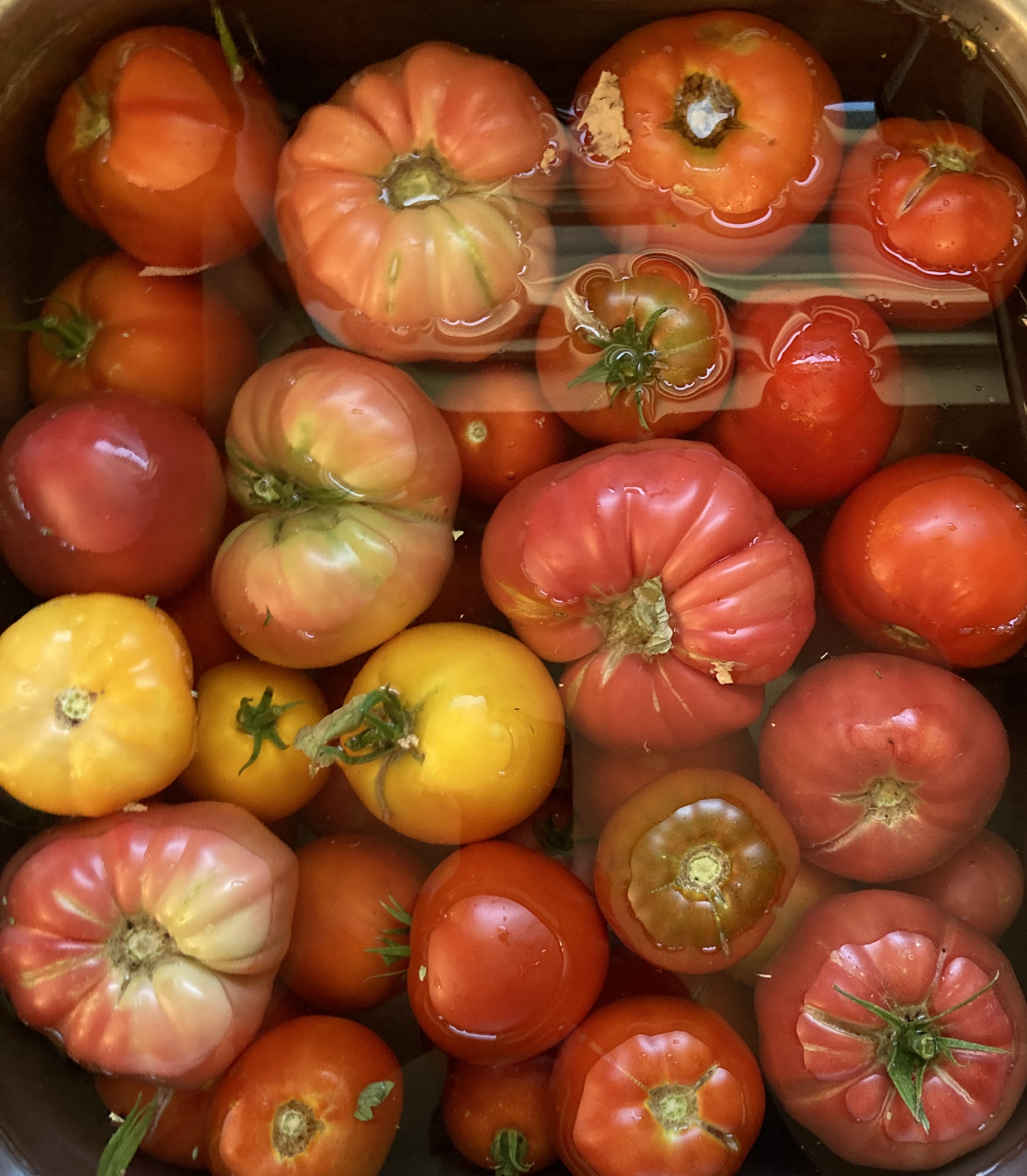
The photo you see pictured to your right is just one part of it. I picked this for a canning project last weekend. This sink full of ripe heirloom tomatoes came from approximately half of the plants in the garden. I'm still harvesting from the other half that didn't get touched, hoping that my neighbors don't get tired of my never-ending gifts of vine ripened tomatoes.

I've stopped waiting for the 101st Airborne Rat Army to show up. It's nearly September now. In the past two or three years, this garden would have been decimated from top to bottom by now. Every tomato still on the vine would be damaged with large and disgusting chunks in the shape of large, sharp rat teeth. It was impossible to walk down the garden rows, unless you enjoy rats suddenly zipping across your shoes as this walk interruped their non-stop feeding regimen and garden destruction habits. It was really something to experience. Depressing too.

Single Plant Harvest
But the introduction of "The Mango" as my neighbors now call him (they did name him, after all), has meant all the difference in the world. I kept waiting for weeks on end for the 101st Airborne Rat Army to parachute in on any given night and lay claim to the ripening heirloom tomato crop. They never did. Not with The Mango, my tiny orange rescue kitten from the Bradshaw Animal Shelter, now patrolling the garden area.

His presence has resulted in what is pictured above left. That isn't a harvest from my heirloom plants. That's from ONE plant. Plus, that is just the harvest from that ONE plant on the day this picture was taken. I've been pulling tomatoes off this ONE plant for weeks. It's still loaded with tomatoes that are still green at the moment. Which means another monster harvest from this ONE plant is coming soon.

Processing Tomatoes
So, with heirloom tomatoes literally coming out of my ears, it was time to put some old gardening tools to work again. This would result in a project I had not undertaken for nearly a decade. I would turn a sink full of vine-ripened heirloom tomatoes, garden bell peppers and jalapeño peppers, garden grown onions and basil, and turn it into as many jars of spicy tomato sauce as I could get.

This was an all-day job for two people a decade ago. I'm alone now. I wouldn't be all that surprised if this job took me more than a full day. That did happen, but only because I ran out of canning jars and the all important canning jar lids. The lids are the one thing you cannot recycle. Once they've been used, you cannot use them again.

Simmering Sauce
I'm not sure why I chose to hang onto all of the old garden canning equipment when I found myself living alone again. Anyone who has been through this experience, and a lot of us have, will find themselves throwing away a lot of old and unpleasant memories. This I did through the years, but I kept the old water-bath and pressure-canning equipment sitting on a shelf in the garage. It had gathered a fine layer of dirt and dust through all those years of inactivity. But you know what? You can wash the dirt off. You can enjoy life again.

Turning a sink full of heirloom tomatoes and peppers into jars of spicy tomato sauce is a fairly simple task once you've done this a few times. The first step is to wash and core the fruit. It's then cut into chunks and liquified in a food processor. The amounts are then measured and added to a large pot. Once everything is added, you bring the mixture to a boil and let it simmer.

The Payoff
I wanted a thicker sauce this time. So, rather than just one hour of a hard simmer, I kept it going for two. It's useless to keep an air conditioning unit working during a project like this because the heat coming out of the kitchen is fairly intense. Of course I would choose the hottest day of 2022 to take on such a project. That only makes sense. I had forgotten about the kind of heat that comes out of a kitchen when a pressure canning unit is hard at work.

The end result is 13-pints and three quarts of the thickest sauce I've ever created. Do you really think I'm going to consume this much heirloom tomato sauce during the winter? Are you insane? That's what neighbors are for. The same neighborhood children who gifted my orange rescue kitten with the name of "The Mango" will get to enjoy the results of his non-stop garden patrol efforts.

The Mango
If "The Mango" enjoyed tomato sauce he would most certainly get his fair share. After all, he earned it. But, he's more than content with his kitten kibble. The only snack he seems to enjoy is the ocassional bug he hauls in from the backyard. This is one garden assassin who works cheap.

Sunday, August 14, 2022

The Most Interesting Tomato Plant of the Month! August

Garden Protector at Work
I don't always grow tomatoes. But when I do, I grow the fattest, most colorful and tastiest of heiroom tomatoes! And this year, thanks to that creature pictured to the right, I'm enjoying a banner harvest for the first time in years.

That's right! Heirloom tomato season is now officially underway in these parts. The plants are literally producing so many tomatoes at the moment that I'm literally begging neighbors to take them from me.

In the past, I might have tried to can some of this bounty for winter use. I do have recipes for numerous tomato sauces. I've done it before. But, so far, the energy just eludes me. Most of my time is spent harvesting, packaging and delivering this enormous haul to neighbors here, there and everywhere.

Kellogg's Breakfast
Which brings us to the most interesting tomato plant of the month. It's August. This is the month of heirloom tomato production in California. In past years? An army of rats would have decimated this garden by now. The only pictures that I could show at this point in the garden season were photos of heirloom tomatoes that were half eaten, covered with aphids and other bugs, and just plain spoiled.

But that isn't the case in 2022. Mango, the kitten rescue procured from the Sacramento Bradshaw Shelter has somehow managed to keep the ravenous rat army, every last one of them, at bay. I haven't lost a single tomato to a rat raid. There are no rat raids. No other wildlife raids either. The creatures who feasted on previous garden efforts last year, the year before that and even the year before that, are avoiding the garden like it's some sort of plague.

Which is just fine by me.

1.5 lbs.!
The most interesting tomato plant of the month is a variety I've grown before, but never enjoyed the bounty of a harvest like this one. This variety is called Kellogg's Breakfast. It is considered to be one of the finest open-pollinated tomato plants ever developed. It received it's name, not from the makers of Kellogg's Breakfast Cereals, but a railroad supervisor by the name of Darrell Kellogg.

This variety hails from West Virginia, but Kellogg helped to popularize it from his gardens located in Redford, Michigan. The food editors at Sunset Magazine declared it as one of the best heirloom tomato varieties ever developed, and legendary heirloom grower Carolyn Male made sure to list Kellogg's Breakfast in her time-honored garden bible called 100 Heirloom Tomatoes for the American Garden.

Heirloom Tomatoes
This variety was christined with the name of "breakfast tomato" because of its unique and outstanding orange flesh and orange colored juice. It is simply one of the sweetest varieties you will ever have the pleasure of tasting, and just one of these tomatoes can fill up a standard serving bowl once it's been sliced into delicious, mouthwatering chunks. It's also a favored slicing tomato that's been known to cover more than a few Bacon, Lettuce and Tomato sandwiches.

Kellogg's Breakfast is one of those few late-season rewards that heirloom tomato growers dream about all winter and spring. The season is never quite long enough, no matter how productive the plant might be. These fruits easily top 1 lb. and a few might even tip the scales at 2 lbs. or more. It's not a perfectly round tomato. No heirloom really is. Most heirloom tomatoes look like garden nightmares. Kellogg's Breakfast is no different. It's lumpy, bumpy and just plain good.

YUM!
The garden is producing lots of tomatoes like this at the moment. So much so that choosing a "tomato variety of the month" proved to be difficult. There are others in that garden of mine who are attempting to knock Kellogg's Breakfast off its lofty perch, but that is a tough task for an heirloom delicacy like this one.

Grow Tomatoes, my friends.

<b>The Countdown IS On!</b>

HEAT BRICKS! It's January. It's COLD outside. If the high winds aren't whipping all the warmth from your gardening soul at the ...