Showing posts with label California. Show all posts

Sunday, March 19, 2023

A BIG Year for BIG Hydro?

Back to the Future!
1.21 Gigawatts! Great Scott!
A favorite line from a favorite actor in one of my favorite movies. Thanks to the rain and snow that continues to hound California, there *should* be more than enough electrical currents in this state to power dozens of Flux Capacitors all summer long.

It is the month of March in Northern California. During a normal year, I would be busy digging up the garden right about now. I would have already planted onions and potatoes. The next step would be tilling up and preparing the main garden area for all sorts of summer vegetables.

This year, however, has been anything but normal. The onions and potatoes are not planted. The section of the yard set aside for these efforts was under several inches of water just a day or two ago. The main garden area, meanwhile, resembles a mud pit. From a gardening standpoint, everything is on hold for the moment.

This may sound like terrible news, but it's not. It's a minor inconvenience. The onion and potato planting party can wait. Mother Nature isn't quite done yet. Another storm or two is in the immediate forecast. This means more rain, more mud in the garden and more snow in the high country. A lot more snow.

Lake Tahoe Snowpack
This bounty of rain and snow that Mother Nature has provided for us in the 2022-2023 winter season is a blessing in many ways. It means more than enough irrigation water for backyard gardening and fruit growing efforts like mine. Commercial agriculture *should* get close to 100-percent of irrigation water deliveries from the state and federal water projects. This will, in turn, reduce or even eliminate pumping for groundwater supplies for many farmers and ranchers.

What farmer needs to pay for electricity to pump water from a well when the canals, holding basins, lakes and reservoirs are full of water? Which they are at the moment, thanks to this winter's non-stop rains. When the rain eventually dries up and the weather warms, the real bounty will come with a record snowpack in the Sierra Nevada that begins to melt. Hopefully, it's a slow melt.

But the biggest payoff should be an abundance of electrical power to run every single air conditioner and light up every light bulb in California  this summer and every other western state with a connecting electrical grid. The power producer known as BIG Hydro is primed and ready to deliver a BIG year.

Lake Oroville-Courtesy Bill Bailey
What exactly is BIG Hydro? There are many definitions. The U.S. Department of Energy defines it as "facilities that have a capacity of more than 30 megawatts (MW)." Other definitions put that number at 10 MW, but you get the idea. It's a boatload of electrical power. The BIG Hydro plants in California are primed to deliver a very big year indeed. This number will be so big that it won't be measured in megawatts, but rather gigawatts (GW).

One GW is a LOT of power. How much? It's enough, obviously, to power a single Flux Capacitor (almost). In more conventional terms, however, you would need roughly 3.1 million photovoltaic panels (solar) or 333 utility-scale (very large) wind turbines to achieve that kind of electrical output. In terms of horsepower, you could possibly generate that same kind of electrical kick with a horse race featuring 1.3 million horses.

Shasta Powerplant-Courtesy KRCR-TV
The Shasta Powerplant located at the base of Shasta Dam, California's largest reservoir, can generate more than 700 MW of power when the reservoir is full. That's enough juice to power 700,000 homes and businesses. This is just one BIG Hydro plant. There are numerous others.

The Hyatt Powerplant, Thermalito Diversion Dam Powerplant and the Thermalito Pumping-Generating Plant are all located at the base of Lake Oroville in Butte County. Combined, all three can also generate more than 700 MW of power when Oroville is full of water. That won't be a problem this year as Oroville has already reached the point where large water releases have already started thanks to a monster snowpack in the Feather River watershed located above the lake.

Oroville Spillway-Courtesy Bill Bailey
Speaking of the Feather River watershed, you shouldn't miss the opportunity to drive up Highway 70 into God's Country this summer. The show of spring and summer wildflowers should be a sight to behold. Not only does this drive offer the pure, stark beauty that is Northern California, it's also home to the "Stairway of Power." The entire river canyon has been transformed into one BIG Hydro plant after another.

Why is all of  this so important? Hydroelectric power is nothing new, after all. This is a true statement. Yet, among all forms of power generation in this country and elsewhere, even in this day and age, BIG Hydro is still the cheapest, cleanest, safest and most reliable form of power generation on the planet. Check that: It's only reliable if the rain and snow fall in any given year. If the rain doesn't fall or the snow melts away quickly, that reliability factor gets a bit "iffy."

That "reliability" factor is important. California gets summer power from a variety of sources. The 2021-2022 season was a dry year indeed. Dry years spell big trouble for BIG Hydro. The combination of power from both big and small hydro projects amounted to a measley 14 GW of power. That small number forced utility companies like Pacific Gas & Electric to burn natural gas supplies to make up the difference. A lot more.

Hyatt Powerplant-Courtesy DWR
This year, however, should tell a far more pleasing story. There's enough "juice" (water) in the Northern and Central California watersheds to power big and large hydroelectric plants all summer long. The last big year for BIG Hydro came in 2017. The combination of big and small hydroelectric generators produced nearly 44 GW of power.

That's enough power for nearly 36 Flux Capacitors if my math is right (31 million homes). Of course, you may need to visit a few California junkyards to find that many DMC DeLorean Time Machines.

Sunday, September 4, 2022

The Most Interesting Tomato Plant of the Month! September!

Tomato Plant of the Month
I don't always grow tomatoes. But when I do? I grow some very strange plants that cannot be identified. This is what it is like to grow your own tomato garden, my friends. Sometimes you know what you are growing. Other efforts are complete surprises. That is the story behind the Tomato Plant of the Month for the month of September. I cannot begin to tell you what variety it is.

I've chosen this one plant for a reason. The picture located above right is an example of the harvest from this one plant. That is not the total harvest. It is just the harvest that came off this one plant on the day I took this picture. That's why I took the picture to be completely honest. This one plant, the plant of the month, has been churning out round and red tomatoes since early July. It is still churning out tomatoes in the month of September. I could have taken five more photos of the daily harvests from this one plant, but WHY?

Mystery Plant
I can tell you one or two things about the September Tomato Plant of the Month. It is not what tomato growers call a "Determinate" tomato variety. This list comprises a small number of varieties. They are marketed under names like Early Girl or Better Boy and a few others. These types of "Determinate" varieties, which also include some types of Roma or Paste tomatoes, will usually result in one large harvest. The plant might spit out a few more tomatoes as the season progresses, but the idea behind "Determinate" plants is one big harvest.

Indeterminate plants, which are also known as "heirlooms," are different. They will also produce one big harvest. They will also produce a second big harvest. If you're lucky, you might even receive a third big harvest. Indeterminate, or heirloom, plants take a bit longer to ripen than the determinate varieties. But, the advantage is they don't stop producing. They will keep forming new tomatoes throughout the growing season. I live in California. The tomato growing season here can be very long. It can start as early as March and keep right on going until the Thanksgiving holiday arrives in late November.

Plant of the Month
As much as I would like to tell you the name of this variety, I cannot. This is due to a gardening "accident" that took place earlier this year. The seedling plants that I received had been scattered about due to this accident. Which means every plant was a complete and total mystery. As these plants started to grow and produce ripened tomatoes, I could correctly guess the names of some varieties. The "Lemon Boy" variety was easy to spot because those tomatoes turn yellow when ripe. I could also spot the Kellogg's Breakfast plant, because those tomatoes ripen into a pleasing shade of orange.

However, most tomato plants produce round and red tomatoes. The vast majority of the tomatoes in this year's garden produced round and red tomatoes. How can you tell them apart? The short answer is: you cannot. You just enjoy them. You turn them into a lot of tomato sauce or canned tomatoes. You give them away to friends and neighbors. That is what I've been doing with the tomatoes from the September plant of the month since July. It started to produce early. It is still producing in September. It may keep right on producing through the months of October and November. I really don't know.

Tomato Sauce Project
I have been fortunate (lucky) enough to grow some varieties that have been as productive as this one plant has been. The variety known as Druzba comes to mind. Druzba is an heirloom that came to America from Bulgaria. This variety also produces a ridiculous amount of red and round tomatoes throughout the growing season. This variety produces tomatoes that ripen early. It also produces tomatoes that will ripen in November, provided the weather cooperates. But, the September Tomato Plant of the Month is not a Druzba. How do I know this? Because my tomato growing buddy who provided me with starter plants during spring planting efforts did not plant Druzba seeds.

So, while this plant may act like a Druzba, it is not a Druzba.

I suppose the name of this plant could also be Prarie Fire, Bella Trix, Say Brook or Original Blue Ribbon. These are varieties that produce red and round tomatoes. These are also seeds that my tomato growing friend DID plant. So, I suppose it could be one of these. Except, all of these varieties are listed as Determinate. This means one big crop of red and round tomatoes and not much else. That doesn't match what I'm growing.

Lots of green tomatoes
The bottom line is I'll never really know for sure. But it really doesn't matter. Because backyard tomato growers pray for production like this. It's a non-stop harvest so ridiculously large that you will never eat them all. You need help.

Thank goodness I have friends and family that love vine-ripened garden tomatoes as much as I do.

Grow Tomatoes, My Friends.

Sunday, August 14, 2022

The Most Interesting Tomato Plant of the Month! August

Garden Protector at Work
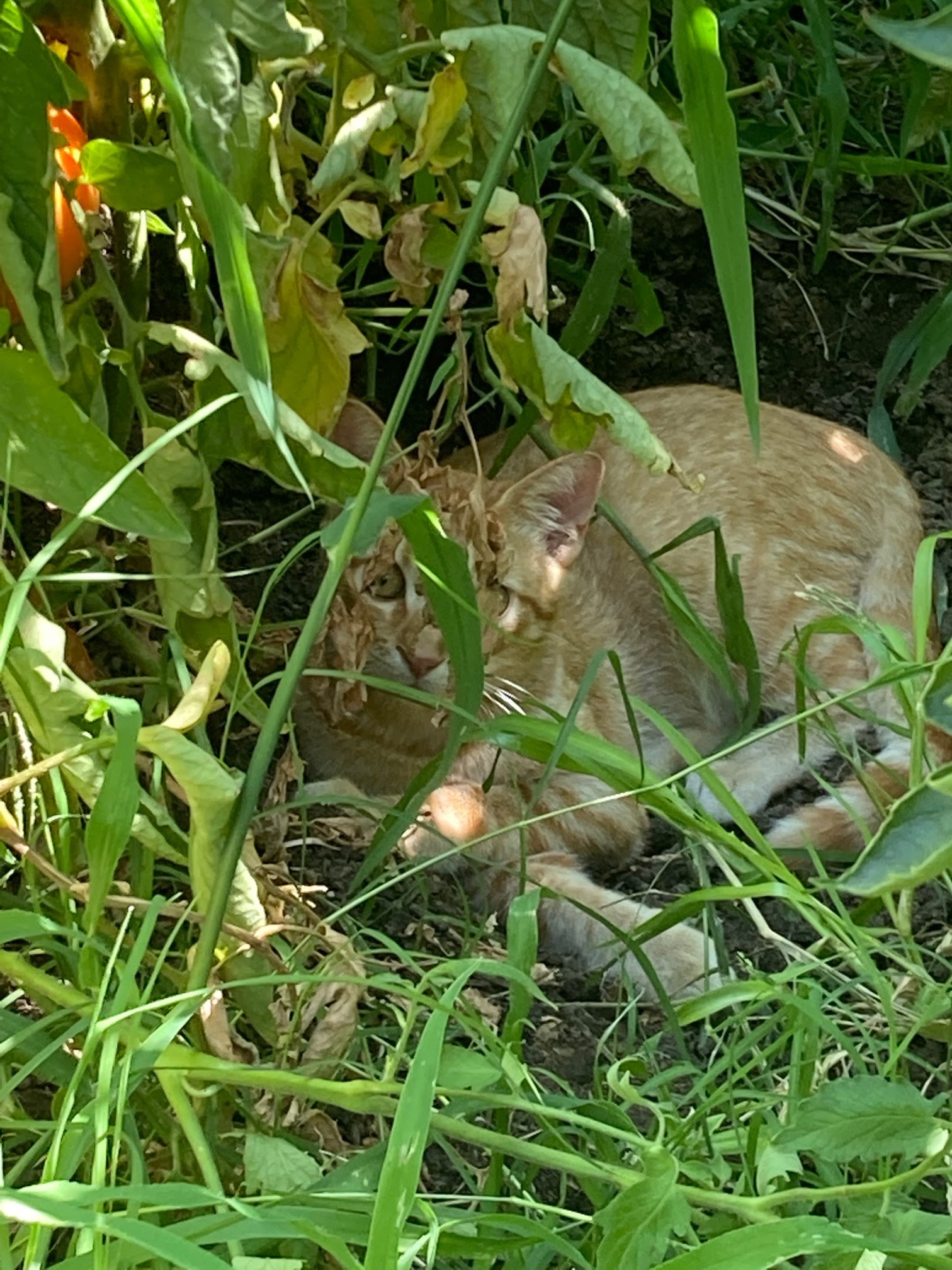
I don't always grow tomatoes. But when I do, I grow the fattest, most colorful and tastiest of heiroom tomatoes! And this year, thanks to that creature pictured to the right, I'm enjoying a banner harvest for the first time in years.

That's right! Heirloom tomato season is now officially underway in these parts. The plants are literally producing so many tomatoes at the moment that I'm literally begging neighbors to take them from me.

In the past, I might have tried to can some of this bounty for winter use. I do have recipes for numerous tomato sauces. I've done it before. But, so far, the energy just eludes me. Most of my time is spent harvesting, packaging and delivering this enormous haul to neighbors here, there and everywhere.

Kellogg's Breakfast
Which brings us to the most interesting tomato plant of the month. It's August. This is the month of heirloom tomato production in California. In past years? An army of rats would have decimated this garden by now. The only pictures that I could show at this point in the garden season were photos of heirloom tomatoes that were half eaten, covered with aphids and other bugs, and just plain spoiled.

But that isn't the case in 2022. Mango, the kitten rescue procured from the Sacramento Bradshaw Shelter has somehow managed to keep the ravenous rat army, every last one of them, at bay. I haven't lost a single tomato to a rat raid. There are no rat raids. No other wildlife raids either. The creatures who feasted on previous garden efforts last year, the year before that and even the year before that, are avoiding the garden like it's some sort of plague.

Which is just fine by me.

1.5 lbs.!
The most interesting tomato plant of the month is a variety I've grown before, but never enjoyed the bounty of a harvest like this one. This variety is called Kellogg's Breakfast. It is considered to be one of the finest open-pollinated tomato plants ever developed. It received it's name, not from the makers of Kellogg's Breakfast Cereals, but a railroad supervisor by the name of Darrell Kellogg.

This variety hails from West Virginia, but Kellogg helped to popularize it from his gardens located in Redford, Michigan. The food editors at Sunset Magazine declared it as one of the best heirloom tomato varieties ever developed, and legendary heirloom grower Carolyn Male made sure to list Kellogg's Breakfast in her time-honored garden bible called 100 Heirloom Tomatoes for the American Garden.

Heirloom Tomatoes
This variety was christined with the name of "breakfast tomato" because of its unique and outstanding orange flesh and orange colored juice. It is simply one of the sweetest varieties you will ever have the pleasure of tasting, and just one of these tomatoes can fill up a standard serving bowl once it's been sliced into delicious, mouthwatering chunks. It's also a favored slicing tomato that's been known to cover more than a few Bacon, Lettuce and Tomato sandwiches.

Kellogg's Breakfast is one of those few late-season rewards that heirloom tomato growers dream about all winter and spring. The season is never quite long enough, no matter how productive the plant might be. These fruits easily top 1 lb. and a few might even tip the scales at 2 lbs. or more. It's not a perfectly round tomato. No heirloom really is. Most heirloom tomatoes look like garden nightmares. Kellogg's Breakfast is no different. It's lumpy, bumpy and just plain good.

YUM!
The garden is producing lots of tomatoes like this at the moment. So much so that choosing a "tomato variety of the month" proved to be difficult. There are others in that garden of mine who are attempting to knock Kellogg's Breakfast off its lofty perch, but that is a tough task for an heirloom delicacy like this one.

Grow Tomatoes, my friends.

Tuesday, July 12, 2022

Fence Post Onions!

Fence Post Onions!
What's this you say? You can actually grow onions on an ordinary fence post? A stick of wood? A perpendicular onion crop? Bunions on a barricade? Shallots on a shield? Of course you can! Would I lie to you?

Stay tuned for the book! "101 Easy and Simple Steps to Grow Onions on Fence Posts." Which would be a big waste of money. Although I have written a book, it's not about growing onions on fence posts. You cannot grow onions on fence posts. Yes, I am lying to you. Despite the visual evidence presented to your immediate right, I did not grow onions on a fence post.

Yes, I did grow onions. No, I did not grow them on a fence post or any other type of wood. However, the onions pictured on that fence post are, in fact, the onions that I set into the ground as young plants on a cold and dark day last February.

2022 Onion Crop
That said? Ye olde fence post is serving a valiant purpose. Besides it's primary function to keep garden-thieving rats out of the garden, it's also a great spot for CURING onions. That's exactly what is taking place right now, at this very moment. My fantastically large onion harvest (featuring red, yellow and white onions) has entered the "cure" stage following this weekend's harvest.

What is The Cure? It's an English rock band. But this isn't the cure you're looking for, nor is it the process I'm describing.

Curing is the process that takes place AFTER the onion crop is harvested. It's a period that can last for as long as two to four weeks and the end result is an onion crop and harvest that will last for months without spoiling. Onions that haven't been properly cured still taste fine. But, even after cooking, they can also be a bit rubbery. I know this from experience. I used two of these small onions in last night's garden soup creation. Even after simmering them for 30-minutes, they were still a tad rubbery.

Enormous Onion
But they still tasted great! Plus, they will taste even better after they've cured in our hot California summer weather for a month or two. That's the nice thing about onions. I can leave them right where they are and they will last until the next crop is planted.

The process of curing dries the onions out a bit. The skins that make up an onion change during this process and get a bit tougher. The sugar in a home-grown onion gets a tad sweeter. The longer these onions sit and cure, the better they get. These are all good results.

There are roughly 140 onions in this year's harvest. Am I going to eat 140 onions? Heavens, NO! That's what neighbors are for. Fortunately, I'm blessed to live around a number of families who all share one thing in common. They all love onions.

Rat Hunter Inspection
Thank goodness they all love Yellow Crookneck Squash as well, otherwise I'd be in trouble. They are all getting squash at the moment. Soon, they will all get onions. Tomatoes, peppers, potatoes and bush beans will soon follow. I keep my neighbors well stocked with fresh produce. I kind of like this role.

This crop of onions is the end result after planting one or two Intermediate Day Sampler packs provided by Dixondale Farms in Texas. These packs arrive as small starter plants, maybe two to three inches in length. They are planted in early to mid February. Once planted, they grow like gangbusters. Or, onions. By early to mid July, it's time to harvest.

I never really did experience a tremendous amount of success with growing onions until I finally followed the advice of others and turned to Dixondale Farms. The fact that this one operation has been providing onion plant starters to backyard growers large and small since 1913 should be enough to tell you that they are doing something right. If the act of growing onions is an art form, they are the American version of a da Vinci or Van Gogh.

Onions Will Make Him Cry
It's a fairly simple task, actually. Just use the Dixondale Farms map to determine if you live in an area designated for Long Day, Intermediate Day or Short Day Onions and place the appropriate order for the area of the country you call home.

How good are these onions? Very good. So good that they just might convince Robert Smith that he needs to do a rewrite on one of the key songs that made him famous.

<b>The Countdown IS On!</b>

HEAT BRICKS! It's January. It's COLD outside. If the high winds aren't whipping all the warmth from your gardening soul at the ...