Monday, August 12, 2024

The HIKE

Sisters Deborah (left) and Mary (right)
"Let me make this really clear,"
she said with eyes that pierced mine, an angry and concerned look on her face. "This is not a video game! There is no reset button! There is no second life! You stay on the marked trail. Do not leave the trail. Do not climb over the fences. If you do you are dead!"

This epic warning from my oldest sister would serve as my introduction to Yosemite National Park, one of the crown jewels of the National Park System. It was my first visit. I was just a boy. My sister had begged me for years to come and visit her there. But I had resisted up until this point. I had this mental image that sister Deborah (Debbie), as a fledgling Yosemite Park Ranger, would attempt to have me hang off a sheer cliff face like El Capitan. Wouldn't that be fun??? NOT! Even at my young and foolish age, I wanted no part of that.

The Yosemite that I am about to describe to you in words and pictures no longer exists. In my youth this park was, in the words of my sister, "underutilized." Reservations? Not needed. Who ever heard of such a thing? Entry fee? To get into Yosemite? GET BENT! To visit Yosemite during this period in time, one only needed to load up the car with camping gear and family. You had your pick of camping spots in Upper or Lower Pines campgrounds, and that choice was usually smack dab on the banks of the Merced River. Cost? Anywhere from $1 to $5 per night. A trip to Yosemite was a "trip on a budget."

Half Dome
No phone calls were needed. No warnings required. The World Wide Web was a World Wide Fantasy. The price of gasoline to fill up the car was getting exhorbitantly expensive at the time, approaching 59-cents a gallon as I recall. But nothing else would stop families from driving directly into Yosemite Valley and parking at the campground of choice. It was that easy. That simple. Traffic jams? In Yosemite? Are you kidding? Far too remote. Not that many people were willing to make that kind of a trip.

You didn't even need an ice chest to keep the cans of beer, soda or bottles of wine cold. That is what the ice-cold Merced River was for. It was nature's ice chest and campers took full advantage of it. There was nothing more refreshing than a can of Olympia or Hamm's beer or Shasta soda at the end of the day that had been "water iced" by the fresh snow-melt waters of the Merced River that coursed through Yosemite Valley and ran straight by our camping spot. No can of cheap grape soda ever tasted any better.

These memories, and a lot more, have been flooding back to me in waves recently. I am recalling events and conversations that I haven't thought about for decades. The recent death of a young lady, Grace Rohloff, is most likely the reason. The 20-year old Arizona State University student slipped and fell from the cables that hikers use to ascend Yosemite Valley's Half Dome in July. She tumbled off a rain-slickened rock face and fell some 300-feet. By the time a rescue team managed to reach her, she was gone.

Yosemite Valley
The story of what happened to Grace has appeared in multiple newspapers and magazines. The tragic event was told to these outlets in detail by her father, Jonathan Rohloff. They were more than just father and daughter. They were hiking partners. The trip up the Half Dome trail is just one of many adventures that the two had undertaken. I feel horribly for Mr. Rohloff. I will never understand this father's pain. But his experience has resulted in a flood of memories.

In the summer of 1977 my two older sisters announced they were going to treat me to the experience of a lifetime. That trip would be a hike into the backcountry of Yosemite National Park where no car could reach. It would result in an overnight camping experience in a remote place called Little Yosemite Valley. It would also mean a trip up the vaunted Half Dome cables. Debbie talked about these cables and this hike often. She was about to introduce me to the experience. That earlier fear I mentioned about scaling the vertical face that is El Capitan was about to come true.

Sister Mary and I. Half Dome Trail
Although I could still describe this ascent up from Yosemite Valley and this hiking trip in detail, I'm going to skip that. Needless to say, this is a trip that took place nearly 50-years ago. Yet, I remember it to this day. I remember it like it took place last week. I don't think anyone forgets an adventure like this. I certainly did not, for many reasons not necessarily connected to this one excursion. It's just an experience that you do not allow yourself to forget.

I can and will tell you the first thought that came to my mind after I had huffed and puffed my way up to the lip of the little dome, also known at the time as "Little Half Dome." This is where the cables that ascend the big round rock called Half Dome came into view for the very first time. The first reaction from my 14-year old brain when I looked at those cables went like this: "OH. HELL. NO." I was already about to drop dead from the trip up just to reach those cables. Now, I would be forced to ascend this monster in front of me? Nope! Not me! I'm not having any part of that!

This is where the term of "sister power" came into play. Both Deborah and Mary announced they were going up those cables. If that wasn't a good enough argument to convince a recalitrant (chicken-hearted) brother, Mary announced she would need a strong man behind her. Just in case she slipped on the cables, you understand. Needless to say, they "convinced me" to make that assault on the cables. They overcame all of the inner voices that screamed "ARE YOU INSANE?" However, to this day I still do have a feeling that if I had refused to hike up that big hill, they would have tied a rope around me and hauled me up.

Half Dome Cables: 1977
A photo snapped by sister Deborah attests to this lineup. Debbie, the strongest in the family, led the way. Behind her came the youngest sister, Mary. Behind Mary came the baby of the family. The spoiled one: me. Do you notice anything else about this photo? Like the complete lack of any other people nearby or below? This was no accident. This was the Half Dome experience in the mid 1970's. If you were brave enough to make the trip up those Half Dome cables, you owned the mountain for that afternoon. Debbie was right. The park was underutilized. This photo is proof of that.

This isn't to say that there were no other people on the Half Dome trail leading to the cables, or other people who accessed the cables at the same time my sisters and I were there. I do remember a handful. But, it was just that: a handful of people. Maybe 10 to 15? Maybe less. I wasn't really looking for them at the time. Nope! My eyes were firmly on the cables and the steep and treacherous side of Half Dome that I found myself on. The only time that I looked up from those cables and that mountain, and I can guarantee you this much, is when Deb told me to look up so she could take the now famous cable photo above.

I can also guarantee you that my eyes and attention went straight back to that mountain I was perched on when that "photo moment" came and went. Another guarantee I can offer is that this section of Half Dome looked nothing like the photo I've placed below. This photo represents the Half Dome experience today. This is today's hiking reality on that Half Dome trail. This is the kind of crowd you can expect to find on this mountain, even with a lottery system in place. My sister's efforts, and the efforts of other park rangers at this time in history, to transform the park from "underutilized" to "utilized" paid off big time.

Today's Half Dome Cables Reality
There's another thing that I like about this photo. There are many such photos of the traffic jam that hikers can expect to find on the Half Dome trail in this day and age. But the one I've chosen to include shows something very special. I saw it for the first time in 1977. I see it in this photo today. You will see a line of people vanish from sight at the very top of this photo. When I first noticed this section from the bottom of the cables I was about to nervously ascend, I reached the conclusion that this point must represent the top of the mountain.

Nope.

I still have a clear memory of what I encountered when I reached this point on that ridge. It's been darn near 50-years since I saw what was over that ridge. I have never forgotten it. As I went over it, I did not find the top of the mountain. No sir. What I did see made my heart sink just a tad further. I was nowhere near the top. In fact, those cables continued up for as far as the eye could see. The hike up to the top wasn't even close to being over. As a matter of fact, it represented the section where the hike to the top of Half Dome got even tougher. To this day I'm still not sure how I made it all the way up, but at some point I did. I was at the top. My sisters and I had conquered the iconic rock called Half Dome.

There are some hikers who celebrate this accomplishment by sitting on the very edge of Half Dome, allowing legs to dangle over the side. Other people will lie down, on their stomachs, on a section of flat rock and inch forward until their head is at a point where you can look straight down. These people are insane. I am not. I wasn't getting anywhere close to any ledge. In fact, as I wandered around the top of Half Dome my mind was occupied on one thought and one thought only. How in HADES am I going to get down?

Debbie Center. Mary Seated
Again, my sister turned park ranger came to the rescue. When a downward facing descent turned into a terrifying assault on the senses (I may have started crying), she suggested that I turn around and go down the way I came up. This turned out to be a fine idea. I turned around, stuck my big butt out for leverage, and assed my way off that Half Dome ledge. I did feel a bit sorry for the handful of people who encountered my big keester as they ascended Half Dome. Although I could move it a tad, that was and still is a mighty big butt to overcome.

As far as safety equipment is concerned, there wasn't any. It was 1977. It either did not exist yet, or these things were not widely available. There were no gloves. Nobody wore a harness. Hiking boots also weren't really a "thing" just yet, although I did have a cheap pair of knockoffs that came from the Montgomery Wards store in Modesto. Those boots, however, did not stop the inevitable slipping and sliding that can take place on those Half Dome cables. This happens, even when the weather is dry. The smooth granite face of Half Dome, polished clean by centuries of ice and snow from previous ice ages, can be that slick. There were points where I lost my footing and my knees met solid granite. There may have been points in that hike to the top where, for short periods, I crawled on my hands and knees. This is not an easy trip. I cannot imagine how people do this type of climb today with so many hundreds of people on these cables. I really can't.

I didn't know it then, but this would be the lone highlight of hiking trips with both sisters. Five years later our family would lose Mary to a car accident. The news, oddly enough, would be broken to me by my sister, Debbie. Mary, who had set a professional goal of becoming the next Barbara Walters, was killed while covering a story for KHSL-TV in Northern California. The job of General Assignment Reporter with KHSL represented the first step in achieving the professional goal she had set for herself since her graduation from the University of Southern California. But her time at KHSL would be short. It lasted only six months. In an instant she was gone.

Debbie with President Bush
A much better fate awaited my older sister, Debbie. 25-years after our hike up the Half Dome cables, this park ranger unknown (at the time) had risen to a rank where she found herself sitting next to the President of the United States. George W. Bush didn't just like my sister. No, love would be a much better term. He found every opportunity to be photographed next to Debbie, as he apparently dragged her from stop to stop during his one-day tour of Sequoia and Kings Canyon National Parks in 2001. Not many people get that kind of access to the President of the USA. I have two of these photos. There are others. I treasure them all.

I feel horribly for Jonathan Rohloff. He watched in abject horror as the pride of his life, 20-year old daughter Grace, slipped off the Half Dome cables and fell to her death. He saw every moment of it. In an instant she was gone. Many computer comment jockeys think he is to blame. "He should have done this," they say. Or, "he should have had safety equipment." It is our reality in today's world. People can be terribly insensitive and this is one big example of it.

Debbie
& The President
There is nothing he could have done
. Not one thing, other than choose to stay off the mountain on this particular day. Safety equipment is a fine idea, but those devices can sometimes fail. I do know that he will be haunted by his daughter's death for the rest of his life. She will come to visit him in his dreams, just as my sister Mary has visited me through the decades. Mary never ages in my dreams. She never got the chance. She will always be the young lady that she was. The young lady pictured above on the Half Dome trail is the lady that sometimes comes to visit when I dream. The death of a child can bring families together or blow them apart. Rock solid marriages can disintegrate because of it. Or, they can sometimes grow stronger. Each situation and each family experience is unique.

This would not be my last experience in a National Park like Yosemite. Having a sister as a Park Ranger or Park Administrator has its advantages and perks. Like access, for one. Or knowing where to go and when to go there. I would go on to hike or travel to places in Sequoia and Kings Canyon National Parks and Yellowstone National Park. My brother and I would hike the trail to Paradise Valley in Kings Canyon. I would also work for part of one summer at a restaurant washing dishes in Sequoia National Park. Traveling through Yellowstone on a snowmobile in the dead of an ice-cold winter is another experience. I will never forget any of these memories. They are stories for another day.

Mary-KHSL TV
EDIT:
My thanks to Cris Hazzard, aka "Hiking Guy." His guide on what hikers can expect in today's Yosemite National Park Half Dome reality is very good. It's a far cry from what I experienced in the 1970's. He was kind enough to allow the usage of some photos from his excursions on the big hike, and is a very good resource for what kind of reality hikers can expect to see and experience in the here and now.

PHOTO CREDITS: My thanks to both Jota Lau and Johannes Andersson for depositing digital images of Yosemite Valley and the valley view of Half Dome on the Unsplash website. My thanks also to the Visalia Times-Delta photographer who snapped the iconic image of my sister with President George W. Bush. I will never remember his name, but I did call to thank him (plus order additional copies of this iconic shot).

REGRETS: I have a few. A big one was failing to save any pictures of Debbie during that 1977 Half Dome trip. She was in a few of them. However, at the time I collected these photos, Mary had just passed. My intent was to find, locate and save each photo of Mary that I could gather. Pictures of Mary and Debbie together were saved, as were photos of Mary with other family members. But I passed on others, which is something I have come to regret.

Tuesday, July 30, 2024

The Most Interesting Tomato Plant of the Month! JULY 2024 Edition!

The Most Interesting Man in the World
Grow Tomatoes My Friends! So says the Most Interesting Man in the world. The world just hasn't been the same nor as interesting when he left that position behind to live the treasured life of a retired actor. I do miss Jonathan Goldsmith. I do miss his quips. I do miss his commercials. I miss his style. Even though I no longer drink Dos Equis beer, I still find time to grow tomatoes!

The Most Interesting Tomato Plant of the Month, for the Month of July 2024 that is, may never be known. Oh, I have pictures of it! It exists. The first picture located below left is proof of this plant's existence! The problem is, I cannot even begin to tell you what this plant is. I didn't even know what it was named when I planted it last May, which is why I stuck it in the corner of the garden that I rarely visit.

Most Interesting Tomato Plant of the Month
Well, let me rephrase that. It's a corner that I tend to visit a lot more now. The reason why is self-evident. LOOK AT THAT TOMATO PLANT! It is positively LOADED with bright pink tomatoes. What kind of tomatoes are they? I cannot tell you. The one thing I can tell you is this: These tomatoes are really good. They are sweet. They slice well. They taste great. They do not show a HINT of disease or any other problem. There have been no LOSERS on this plant. Not a single one. This one plant is responsible for many salads, soups, gifts to neighbors AND a good portion of the early crop went into my first canned tomato sauce project.

That's the sign of a very good tomato plant. It's not over yet either. A big portion of the early crop continues to ripen. Those tomatoes formed up early in May and grew like gangbusters. Now that the harvest period has arrived, the upper portion of this tomato plant is setting and developing a rather eye-popping and large late crop. What kind of tomato plant does this? The Tomato Plant for the Month of July does.

Pink Tomatoes
This tomato plant arrived at my home in early April without a number on it. Check that, the one gallon pot had three numbers on it. Every one of those numbers had been scribbled out. There was a fourth number there. I think. But it was so badly degraded that I could not tell what it was. Therefore, it became the "mystery plant" that I tried to give away. But there were no takers for it. Which is how and why it wound up in a corner. Nobody was interested in taking my plant without a name. Therefore, it became the tomato plant that everyone rejected. Hah! Joke's on them! Everyone passed on the tomato plant of the month!

There are a couple of things that I can tell you about this mystery plant. The Most Interesting Tomato Plant of the Month for July 2024 is a Potato Leaf variety. It is a Potato Leaf variety that yields bright pink, tasty tomatoes. This does not tell me what the variety is. But it does make it interesting. If I were to guess? This is a Pink Brandywine. I supposed it could also be another popular variety known as a Wins All. That is another Potato Leaf variety of plant that also yields pink tomatoes. But, there's just one small problem. I already have a Wins All plant in a nearby section of the garden. While the tomatoes coming off this plant are also pink, the comparison ends there. These are two different tomatoes entirely.

New Crop Forming
That is what led me to my second guess of Pink Brandywine. There's just one small problem with this conclusion. The tomato-growing friend that provides me with all of my starter plants did not grow a Pink Brandywine variety. He has in the past. But not this season. Is it possible that a Pink Brandywine seed could have slipped into his seed starting efforts this past spring? Anything is possible, I suppose. But it's also highly unlikely.

Plant scientists are beginning to pay more attention to the potato leaf variety of plant. A recent report from the The Old Farmer's Almanac Garden Planner seems to suggest that potato leaf varieties were developed in Eastern Europe. In other words, these types of varieties were not widely known in America until the fall of the Berlin Wall and the end of communist rule in Russia in 1989.

Livingston Seed Catalog
However, there's a problem with this theory as well. That problem is Alexander Livingston. He is, or was, an American. He is also known as the Father of the Modern Tomato. It was Livingston who did the groundbreaking work to develop the modern garden tomato we all know and love in North American gardens today. Potato leaf varieties could not have originated in Eastern Europe. Because Livingston developed one at his groundbreaking farm in Reynoldsburg, Ohio. He developed it a very long time ago. No, he was not trading seeds with anyone in Eastern Europe at the time.

That 1887 introduction was given the name of Potato Leaf in one of Livingston's original seed catalogs. According to historical records, however, it's a variety that did not catch on in popularity like other Livingston original tomatoes did. In fact, by 1915, the Potato Leaf was no longer listed in any Livingston catalogs. Perhaps Americans were not ready for the potato leaf yet. Not with a groundbreaking variety like the Paragon.

If there is one thing that modern science can tell us, it's this: The potato leaf variety of tomato plant produces tomatoes that are sweeter and more flavorful than your common, everyday type of tomato plant. That groundbreaking information comes to us from a group of Plant Scientists at the University of California, at Davis (UCD). The study was first published in 2019. The conclusions in the scientific analysis resulted from two years of research and plant testing on the UCD campus.

Grow Tomatoes, My Friends
To quote a small part of the final analysis: "This study revealed the importance of leaf shape to fruit quality in tomatoes, with rounder leaves having significantly improved fruit quality."

I will never know the true name behind this variety. But it does not matter. Because it grows and grows well in the 2024 vegetable garden. It is producing a giant crop and will continue to produce late into the fall season. That is all that matters. That, and the fact that this one reject is the Most Interesting Tomato Plant of the Month for July 2024.

Grow Tomatoes, My Friends.

Friday, July 26, 2024

EMERGENCY!

Garden Bonanza!
A real emergency? No, not really. A bit of an overreaction on my part? Possibly. But, to be honest, I was worried. I still am worried. I have good reason to be worried about the state of the 2024 vegetable garden. It is turning out to be one of the most successful gardens I have ever planted, either directly in the ground or in a series of raised gardening beds.

The picture to your right is just one example of what is taking place in this year's garden. I started harvesting a month ago. A tomato here and a tomato there turned into two or three fairly quickly. Add that to a Sumter cucumber or two harvested from the cucumber patch, and that's a right fine salad for dinner, lunch or both.

But it didn't stay that way for long. Two to three ripe tomatoes per day turned into dozens very quickly when the five plants that I designated as Cherry Row began to produce. Combine that with the heirloom and hybrid tomato varieties that had started to show signs of turning a pleasing shade of pink, red, or yellow and things began to get interesting to say the least. But, I wasn't worried. Not yet.

Cherry Tomato Plant Row
That all changed one week ago. That is when I spotted trouble. The first sign of trouble. A pest known as a rat, or perhaps several, had discovered the ripe tomatoes waiting to be harvested at the base of a Better Boy tomato plant. This one rat, or many members of his or her family, had managed to eat a large chunk out of one very red and very ripe tomato, and had also started in on another ripe offering just behind it.

It has been some years since I spotted any kind of rat or critter damage in the garden. So, I was somewhat surprised to see this kind of critter trouble suddenly resurface. The adoption of a rescue cat from the Sacramento County Bradshaw Animal Shelter put an end to never-ending rat raids that destroyed vegetable gardening efforts of the past. The kids who live next door, and who also love home-grown garden produce, christened my new orange striped rescue with the name of Mango.

Mango Kitten: 2021
That was three years ago. Mango immediately sprung into action the moment I introduced him to the backyard garden in May of 2021. This five-week old ball of fluff immediately owned every row of garden, as well as the fruit trees planted nearby. The rat and critter raids that had decimated the gardens of the past came to an immediate end. Mango caught his fair share of rats, but in reality he scared most of the garden predators out of the yard. Possums and skunks still made an appearance every now and then, but Mango formed a kinship with both. As long as they stayed out of the garden and the fruit trees, all were welcome in Mango's backyard. It was interesting to see those relationships grow and develop.

Unfortunately, Mango developed a bit of a limp last winter. Although it was unrelated to his rat hunting escapades in the garden, it still worried me a bit. Yes, Mango received veterinary care. But, I passed when the veterinarian proposed a surgical solution that carried a cost comparable to the purchase of a new car. There are reasons why I passed. I suppose the biggest reason was that the proposed solution was largely experimental. There was a chance it would not have worked. There was also a slight chance that it would have resulted in a permanent reduction in Mango's ability to walk, let alone run.

Mango on Garden Patrol
Given time, and the onset of summer weather, I had a strong suspicion that Mango's limp would improve with time and rest. It was a correct assumption. Mango's limp vanished as the weather turned from winter to spring. It wasn't long before my rat hunter was springing over fences again and charging after unfortunate dogs who dared to walk in front of his home. All was soon right in Mango's world again. If you don't believe me, just ask the poor German Shepherd that dared to lift his leg on the corner of some inviting grass in the front yard. Mango plays with all dogs who choose to visit. Or launches a surprise attack from beneath a bush or car.

The recent discovery of serious rat damage in the garden, however, surprised me a great deal. No rat had dared to visit since Mango started his daily patrols as a small kitten. It did not take long before that recent discovery of rat damage led to another distressing sight. Mango showed up a moment later, limping badly on the same back leg that troubled him a great deal last winter. I knew immediately that Mango had done battle with a large rat or several rats, and those garden raiders had managed to get the better of him. Or, that was the initial belief. It's been a week since that discovery, and the rat or rats have not returned. There have been no further raids on the garden. Mango's limp, meanwhile, has improved somewhat dramatically.

Mystery Potato Leaf Heirloom
This did not stop me from stripping the garden of every last ripe tomato on the vine. I was not going to wait and risk further rat raids that would have laid waste to garden growth efforts. This was a very early harvest compared to years past. I normally have to wait until late August to see this kind of production out of the garden. This year, however, is proving to be one of those special production years. It might be the record heat that has hammered Northern California this summer. It could also be some changes I adopted in providing water to each tomato plant. It might have been some changes that I adopted when I prepared the garden area for spring planting. Or, I suppose, it just could be one of those years. I'm not sure.

I can only tell you that prime tomato production season has arrived early this year. Every plant in the garden, from hybrids to heirlooms, is sporting a fantastic early crop and enough green tomatoes to guarantee a fantastic late crop. Most of the late production is springing from the heirloom varieties like Caspian Pink, Pruden's Purple, Black from Tula and Watermelon Beefsteak to name a few. This is completely normal. Heirloom varieties are known to deliver bountiful crops both early and late.

Brewing Tomato Sauce
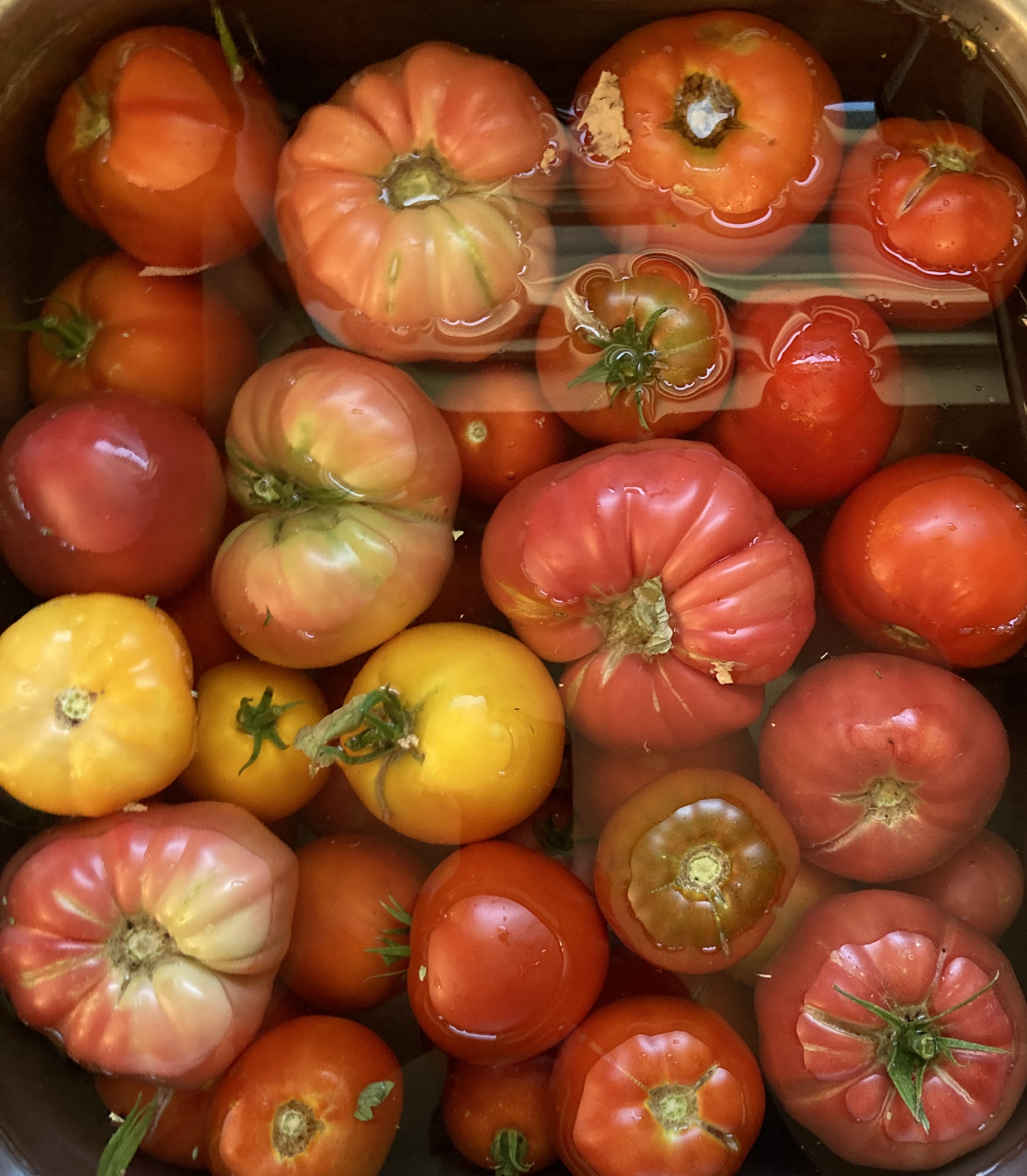
Hybrids are a bit different in respects to production. Those time honored favorites like Better Boy, Better Boy Plus, Big Beef Plus and Steak Sandwich Hybrid tend to produce one big crop. They tend to ripen at the same time and ripen earlier in the season than heirlooms. Which works for me. It makes for a nice garden mix. A sink full of red, pink, black and yellow colors is a pleasing sight to behold. It also means a lot of work!

As for the rats that made an unwelcome visit one night and took chunks out of two big Better Boy tomatoes, they have not returned. This is surprising because rats are very smart creatures. Once they discover a food source they normally make a return appearance. But, they have not returned. I'm fairly certain that it is due to Mango's patrol efforts. He has not provided me with any garden gifts just yet. Which is fine by me. As long as he keeps the raiders out, I'm fine with it. The rats have not returned to the garden, nor have they attempted to raid the black fig tree nearby. This is another welcome development.

Heirloom Tomato Sauce
My recent "EMERGENCY" harvest moment resulted in enough tomatoes, sweet bell peppers, hot 
jalapeño and paprika peppers, onions and basil to create 15-pints and five quarts of thick garden-grown tomato sauce. It has also resulted in multiple cherry tomato deliveries to the five children who live next door. They can't get enough of them. That kind of appreciative audience works for me. I hope you experience the same type of blessing.

EDIT: I am always listening to the advice of other long-time gardeners. Many are suffering from raids by rats or other wildlife this season. Rats are showing up in backyards where they have never paid a visit before. There are some gardeners who suggest that these raiders are, in reality, stressed by our extraordinary heat this summer combined with a lack of water. They have suggested bowls of water placed strategically outside of garden areas. This sounds like good advice to me.

Tuesday, July 9, 2024

Beans! Beans! Beans!

Garden MESS!
Tonight's dinner vegetable comes to the table from that garden mass (or mess) to your very right. At one time, that big lump of greenery once looked like the straight rows of seeds that I planted in May. Those perfect and straight rows lasted for about all of five garden seconds. Then, the cucumbers ran over and strangled everything. Including the lawn.

There's basil in there! Three different varieties of basil I might add. You just can't see it unless you strain the old eyeballs. Another item in that garden mess is bush beans. There are two different varieties that I planted. Somehow they've managed to survive the cucumber vine onslaught that devoured all the space I set aside for them, and they are now producing some nice looking beans.

I harvested a few of them for dinner tonight, along with some basil. They will go nicely with the chicken legs that are currently marinating in a mixture of lemon juice, garlic salt, seasoned salt, and pepper. There's no big secret to preparing green beans, at least not in this house. I will cut off the stems and probably cut them in half, and then steam them for 10-15 minutes until they reach the desired level of "done" that I'm happy with. After draining off the water, I will mix in about a tablespoon of butter and perhaps a half tablespoon of chili garlic sauce that I have handy.

Bush Beans and Basil
If chili garlic sauce isn't your style because of the heat involved, I can always default to a jar of Tom Yum paste that I use in my favorite soup creation.

The bush beans represent one of the cheapest things to come out of the garden this year. All of the varieties that I planted, about eight seed packets worth, are heirloom varieties. Heirloom means old. These are the bush bean varieties that came out of your mother's garden, or perhaps your grandfather's garden location or maybe even great grandfather. They've been around for a very long time.

There's a reason why they've lasted so long. It really doesn't matter where you plant these bush bean seeds. They seems to do well from one end of the country to another. Specific climates don't really come into play here. Nor does the planting location. Seeds can be sown directly into the ground, or even a pot filled with gardening soil. The end result is they grow like the dickens. They also produce a boat load of seeds. Those seeds produced by commercial farmers go right back into the nation's gardening supply and wind up in seed packets that are still sold at a very economical (CHEAP) price.

Most of the beans that I harvested today and are pictured above are of the Cherokee Wax variety. They are a milky yellow-white in color. There are a few different stories about how this bush bean was discovered. I'm not sure which one is correct, but I can tell you one story is rather sad.

Cherokee Wax Beans
The first story is that the Cherokee Wax bush bean comes from the Cherokee people that are native to North America. It is believed that the Cherokee grew them for generations in the Great Smoky Mountain range of Tennessee and North Carolina. It is further believed that the Cherokee people carried these seeds with them during the Trail of Tears of 1838-1839, when they were forcibly moved from the Smoky Mountains to Oklahoma.

The second story is that the Cherokee Wax bush bean comes from agricultural research done at Clemson University in South Carolina. This variety was first released to the public in 1947 and has become a standard favorite in just about every American garden. Did Clemson University receive seeds for this bean from native Cherokees? That answer is probably a resounding yes, but I am not sure either. There's also a third story that this bean originated in the Andes region of South America.

Regardless of where it came from, I can tell you this is a great bean dish to have at the dinner table. They can also be canned for future use, a project that I may undertake with a second crop that I planted about a month after the first planting effort.

25-Cent Seed Packets
The second variety of bush bean that will be at tonight's dinner table is called Top Crop. Also known as TopCrop, this variety is a 1950 All-America Selections (AAS) winner. It was reportedly developed by Dr. W.J. Zaumeyer, who is listed as working for the United States Department of Agriculture in a 1930 crop report issued by the University of Wisconsin. These are green in color, and like the Cherokee Wax bean, are very good.

It's safe to say that I love bush beans. They are cheap seeds to buy and easy to grow. Bush beans make a fine side dish, and are welcome additions in soups, stews or anything else you may want to add them too. If I don't get around to canning a jar or ten, large amounts are tossed into a freezer-safe bag and frozen for future, winter usage.

These bush bean plants were not at all bothered by our recent heat wave in Northern California and, because of that heat, are a tad early this year. This does not bother me in the slightest. Food from the farm in back is always a welcome addition.

Sunday, July 7, 2024

The Most Interesting Tomato Plant of The Month! JUNE 2024 Edition!

The Most Interesting Man in the World
Grow Tomatoes My Friends! Fine words of advice indeed from a treasured actor like Jonathan Goldsmith. He used his persona as The Most Interesting Man in the World to convince you to drink Dos Equis beer. Which isn't a bad idea. But I'm using his character for a much different and healthier reason.

I don't think he will mind very much.

I do know that I'm a tad late with this blog post. After all, it does come about seven days into the month of July. But I have been dealing with a bit of a difficult heat wave in Northern California at the moment. While it seems like it's been two straight weeks of temperatures at or near 1001 degrees, that's a tad facetious. However, I can tell you that it's tough to do anything in the garden over a long period of time when the mercury hits 110. Which it has. Far too often for my liking to be brutally honest.

Don't get me wrong here. Summer vegetable gardens LOVE heat. Those summer producers love everything about bright sunshine and sizzling hot afternoons. As long as they get enough water, everything in the vegetable garden world is as good as it gets. Peppers, for example, LOVE heat. Hot peppers and sweet bells love it equally. Given them enough water in a heat wave like this one, and they will respond with record growth and happiness.

Pink Vernissage Tomatoes
The same is true with just about everything in the summer garden. This includes The Most Interesting Tomato Plant of the Month. This is a large cherry variety. It's about the size of a golf ball. It is one of six cherry varieties that call the garden home this year. But this one is a tad unique. It's not native to California. It's not native to the USA. It comes to my garden by way of a Eastern European country that's been in the news for the last few years. That country is Ukraine.

There's a Russian tomato grower there who is attempting to do all sorts of increidble stuff with my favorite summer fruit. He is the Ukrainian copy or counterpart of California's own Brad Gates, the founder of the Wild Boar Farms collection of unique tomato varieties. The cross-breeding done at the farm of Ruslan Dukhov has resulted in my Tomato Plant of the Month: Pink Vernissage. Dukhov runs his experimental tomato breeding farm in an area called Mushirin Rog. That is in the Dnepropetrovsk region (Oblast) of Ukraine. Please don't ask me to type that out again, let alone try to pronounce it.

The Pink Vernissage, according to Dukhov, is a cross between the Stupice (Stoo-Pick) tomato variety and another that is local to Dukhov's region. it's called the Kitaiskiy Barkhatnyi. Please don't ask me to pronounce that either. I could barely type it. I've grown Stupice a number of times. It hails from Czechoslovakia, near the town called Stupice. It is a time-honored favorite in Eastern Europe, and was one of the first varieties introduced to American growers after the fall of the Berlin Wall in 1989. Stupice is one of those varieties that seems to grow extremely well no matter where it is planted. This includes a crack in a sidewalk.

Pink Vernissage Clusters
The Pink Vernissage, or Vernissage Pink as some seed websites call it, is as unique as the striped varieties that have been developed by Gates at Wild Boar Farms. Loosely translated, the term Vernissage means art. It certainly is that. This unique tomato variety is both spotted and streaked with colors of pink, brown and orange. Like every tomato that is vine-ripened in extreme heat and sunshine, every bite is a delight to the tastebuds. My Pink Vernissage plant produced the first ripe tomatoes of the summer season and continues to set clusters of four or six tomatoes on a plant that is now reaching six feet in height. It's open-pollinated, which means it will continue to deliver fruit until the frost of winter shuts it down.

Pink Vernissage isn't Dukhov's only contribution to the world of unique tomato varieties. He's responsible for dozens more. This includes other contributions in the Vernissage variety that carry colors of green, black and yellow. If there is one difference between the work of Dukhov and Gates, it's this: Gates isn't doing his experimental work smack dab in the middle of a war zone. Dukhov, unfortunately, is. His farm is uncomfortably close to the front lines of the conflict between Russian and Ukrainian forces. While it seems that soldiers would not at all be interested in raiding a tomato farm, that hasn't stopped errant shells from falling. One of those misfires reportedly damaged a greenhouse.

Pink Vernissage
That hasn't stopped Dukhov from doing his wonderful work with tomato plants at his small farm. He has a website, which is in Russian and tough to follow. He also posts videos on YouTube, which are also in Russian. Which means it can also be a little tough to follow. Unless you know Russian. Which I do not. Despite the language difference, there is an infectious excitement in his voice when it comes to discussing his favorite subject.

Every tomato tells a story it seems. The Most Interesting Tomato Plant of the month certainly does that and more.

Monday, June 24, 2024

The DRAMA Queen

WILT from the DRAMA QUEEN
Every garden has one. So does mine. I am not immune. The top portion of this tomato plant featured to your immediate right came to my garden this year with the title of "Sandwich Slicer." I am of the opinion that the name of it should promptly be changed immediately to DRAMA QUEEN. What tomato plant doesn't enjoy about 12-hours of direct heat and sunshine? This one, apparently.

Look at that thing! Just the sight of it will send a signal that it needs a good, long drink of cool, clean, water! Except, it got one this past Sunday. An exceptionally long drink of life-sustaining water from a hose set on a slow trickle. The plant, and the soil around it, was positively drenched with water following that 30-minutes of watery attention.

Other plants in the 2024 Tomato Garden look positively wonderful after receiving similar watery attention this past weekend. I took every effort to ensure that each tomato plant was treated to a low trickle of water over a long period of time. Every plant was treated with that slow trickle treatment for 30-minutes or longer. Plants in every vegetable garden do best with heavy, infrequent watering schedules. They don't need a drink every single day. They do best with that slow drip or trickle attention once or twice a week.

"Help Me! I'm Dying!"
Yet, there's always one malcontent in every vegetable garden collection. Two years ago it was roma tomato variety called Korean Long. Which is a very fancy name for one very average roma tomato. The Korean Long received more than enough water. Yet, as soon as our famous summertime temperatures broke the century mark, it started to put on a show just like the one you see out of this plant in the 2024 tomato garden.

Worse yet, I'm not even sure if "Sandwich Slicer" is the right name to apply to this garden drama queen. Google tells me the variety came to me by way of Burpee Seeds. Which isn't surprising. Burpee is a seedhouse that produces seeds for a lot of different tomato varieties. Yet, a search for "Sandwich Slicer" on the Burpee website defaults to another variety called the Steak Sandwich Hybrid. Which is another large slicing variety. Are they the same? Good question! According to Burpee Seeds, they must be. But, who knows?

The Steak Sandwich Hybrid is not a horrible tomato variety. I actually trialed it some ten years ago after Burpee made a big fuss about this new offering in the 2014 catalog they issued that year. I do recall the seed price wasn't cheap. No "new" variety of tomato seed is. But, if I was going to waste another dollar or two on an interesting variety, it was going to be for something like "Steak Sandwich." That's good marketing. Almost as good as sticking a very average roma tomato with the name of Korean Long.

Drama Queen Production
By the way, the moment the sun goes down this thing perks right back up again and looks. well, normal. It looks the part of a healthy, happy tomato plant in the 2024 garden. Because it is. Gone is the viscious, drama queen like, wilt. Gone are the signs of some kind of disease-causing wilt. Thanks to the unique weather patterns in the six-county Sacramento Delta region, cool air flows right in from the Pacific Ocean following a blistering hot summer day. This is why tomato plants do so well in this region, and why much of the farmland in the region is dedicated to the growth of processing tomatoes. Like the roma. Plus others.

Need proof? Look no further than Yolo County, just west of my home in Sacramento County. More than 35,000 acres of cropland there was dedicated to King Tomato in 2022. That resulted in about 1.7 MILLION TONS of tomatoes, worth a cool $183 million and change. Most of that coin was realized from the common processing tomato known as the Roma, but then again, some heirloom varieties are also grown there on a commercial basis. But the processing tomato is king in Yolo County. It is the number one crop, by far.

The wilt may look bad, but it isn't hurting production. Not on this plant. At least, not hurting production so far. The "Sandwich Slicer," or DRAMA QUEEN if you will, is loaded with fat, green tomatoes. Plus, our tomato production season is just getting started. The month of June isn't up yet. There's another 3-4 months of solid tomato plant production yet to come. The Drama Queen has tomatoes all over it. Despite the wilt, it looks like it will be a good producer. Providing is doesn't UP AND DIE on me. Which it looks like it just might do. Until the sun does down. Then, everything is right in the Drama Queen's world again.

Friday, June 21, 2024

D-Day and The Tomato

Dad: Red Beach-Dieppe, France 1942
I had intended to write and publish this post on the date of the 80th Anniversary of the now legendary D-Day invasion on the coast of France, but I wasn't quite ready yet. It is the story of two men who greatly influenced my future exploits in the garden. It is part of the reason why I do what I do. When I work in the garden as I often do during these warm summer months, my thoughts are occupied by these two. These two family members did not take part in the D-Day invasion that took place on 6 June 1944. But they were both in this war. They were both either in, or a witness to, combat. They both played the crucial roles that they did.

Later, as a small boy growing up in 1960's California, I noticed the gardening efforts of both men for the first time. My first memory of a ripe tomato on a tomato plant comes from the garden that my father planted and nutured at the home of his second third wife, a lady named Clara. That garden, as I recall, contained corn, cucumbers and tomatoes. The round, red and ripe tomatoes from that misty childhood memory would become a treasured part of a backyard barbecue, as would the corn and cucumbers. It is one of those summer childhood experiences that I've never forgotten. That, and the memory of my brother and I attempting to impale each other with the sharpened metal tips of a well-tossed lawn dart from the infamous game: Slider Jarts.

By the way, that photo above right is a picture of my father. I don't know who took that photo. I just know it was taken at the moment he was captured. That moment came late in the day after a tremendous battle called The Dieppe Raid. This photo was taken shortly after the battle on one of the invasion beaches, known as Red Beach, came to an end. The date was 19 August 1942. It would be the end of dad's war against Adolph Hitler and the German forces that Hitler unleashed across Europe during World War II. D-Day would come and go while dad was locked up in a German Prisoner of War (POW) Camp in what is today a part of southern Poland (Stalag Luft VIII-B, Lamsdorf, Poland).

Francis Doran: Merchant Marines
The second gardening influence in my life would come from the man to my immediate left. His name is Francis Doran. He is (was) my uncle. Francis played the role of older brother to the sister who would later become my mother. His gardening exploits are rather legendary, because he chose to grow his gardens in the worst spot that any gardener could possibly choose: the bitter cold of a Bay Area location where no vegetable in its right mind will grow. Despite those bitter cold summers, Uncle Francis would manage to coax well-shielded tomato plants to grow and produce small pieces of treasured garden fruit. He would also employ the magic of a greenhouse in his backyard to produce champion cucumbers, an exploit that he both relished and celebrated in his later years.

No meal served at his Bay Area home would be complete without a trek down a steep hill in his backyard that led to that greenhouse. That is where the magic of his garden exploits really took place. I have many memories of his triumphant emergence from said greenhouse, fat cucumber in hand. Later, as I began to borrow from the skills taken from him and my father, he would show a tiny bit of jealousy at the garden cucumbers and tomatoes I would present to him each summer that I visited. He also knew, however, that those summer harvests were helped a great deal by the heat of a typical San Joaquin Valley summer season. He wanted no part of that heat and would take every opportunity to tell me so.

Uncle Francis probably would have taken part in the D-Day invasion that took place on the American beaches named Omaha and Utah, but there was one minor problem. He wanted no part of that, and for good reason. Francis managed to live into an old age because he managed to steer clear of the alcohol and cigarette habits that many WWII veterans adopted to cope with the horrors caused by wartime service. Because he did live for as long as he did, I grew to the age where he could speak to me about exactly what happened and what was going through his mind. Today, I treasure those conversations. It is a look into the mind of a young man who badly wanted to serve his country, but also knew he didn't want to become a wartime statistic.

Restored Liberty Ship
"I was not an athlete," Francis explained to me once. "I could not run fast. I would have been the slowest soldier in my platoon. I knew that some German sniper would have picked me out immediately as an easy target and 'POP,' that would have been the end of me."

It is a common belief today that the invasion of France by the Allies in WWII was a well kept secret. Nothing could be further from the truth. Millions of American boys and young men knew as early as 1942 that the Allies would be forced to invade France in order to drive the Nazis out and back into Germany. Francis, who was finishing his final year at the University of Oregon in the spring of 1942, knew this all too well. The moment he received his diploma on the day of his graduation, he also knew he would also receive his draft notice from the U.S. Army Recruiter who was stationed on campus.

So, the day before the big event could take place, Francis and his best friend from college, a young boy named Robert, took proactive action.

"We pulled a fast one on that recruiter," he explained to me, chuckling the entire time. "The day before graduation we went out and joined the Merchant Marines. When that recruiting officer discovered what we had done, boy he was mad! But there was nothing he could do."

Francis was under the belief that his service in the Merchant Marines would keep him safe from the dangers posed by a German sniper. Which it did. What he could not know, however, is it put him at risk from getting hit by a torpedo fired by an Imperial Japanese Navy submarine. It also exposed him to daily attacks mounted by Japanese pilots who flew repeated suicide missions against the U.S. Navy in 1944 and 1945.

Francis in WWII
In fact, the first taste of what he could expect came not long after his graduation. It took place during his service on the first of three of three Liberty Ships he would call home for the duration of the war: SS Henry L. Hoyt. A month after setting sail from San Francisco in July, 1943, my uncle found himself off the coast of a South Pacific island called Guadalcanal. Worse yet, my uncle was onboard an ammunition resupply ship that carried 10,000 tons of bombs and ammunition. His ship, like many other Liberty Ships built for wartime service was, in reality, a floating bomb.

At this point in the war against Japan in the South Pacific, the US Marines and the US Army had managed to drive Japanese forces off Guadalcanal. But that didn't stop the Japanese from retaliating with bombing raids launched from nearby Munda Point in New Georgia. Which is exactly what took place as my uncle worked feverishly to unload his floating bomb on a series of DUKW's. These were amphibious trucks that were used by the Army and Marines to ferry ammunition and equipment from liberty ships to ammunition dumps on islands that U.S. forces had won in battle. It's the same ammunition dump that Imperial Japanese Vals were targeting at the time of my uncle's arrival. He was uncomfortably close.

"All the while (during unloading) the Japanese were blowing up parts of the ammo dump in the hills," my uncle would write in a letter decades after the battle took place.

Unfortunately, for my uncle at least, it was a scene that would most likely be repeated during his service aboard another liberty ship called SS Hiram Bingham. He would spend the final seven months of the war in the South Pacific ferrying ammunition and supplies to islands liberated by either the Marines or the Army (or both) in 1944 and 1945. I am not sure where his service took him on the Bingham, but I do know that one of his last stops would be made in Danzig (GdaƄsk), Poland. He arrived via the SS Murray M. Blum, his third and final liberty ship assignment. He arrived in port not long after the city had been liberated Russian forces and WWII had come to a merciful end.

Dad (Right) in England
My father did not speak much about his experiences during the war. But then again, I was far too young to hear or understand this kind of detail. By the time I finally reached the age to realize where he had been (Dieppe) and what he had done, I was filled with questions that my father could no longer answer. He had been gone for nearly two decades. I don't know if he would have been able to say much had he managed to live to an old age like my uncle did. There are men who saw or did things during the war that they could never talk about, not even decades after the fact. The secrets they held died with them.

I can only tell you what I think. My father was an OG (Original Gangster), provided there is such a thing. He would become the very first American boy, or among the first handful of American boys, to charge up a beach under fire in Nazi-occupied France in 1942. In fact, dad joined the Essex Scottish Regiment of the 2nd Canadian Infantry Division long before America was forced into the war following the attack on Pearl Harbor on 7 December 1941.

His country of birth and citizenship, however, is a fact that did not escape the attention of the Gestapo after he had been captured following the failed Dieppe Raid. A postcard he would send from his POW camp would indicate that the Gestapo had interrogated him about it. One of those questions might have been why an American citizen would join the fight against Nazi Germany in 1940. It is a good question. I did not know the answer. I only just recently discovered an article printed by the Windsor Star newspaper (Ontario, Canada) in July, 1945 where my father claimed to have joined the Canadian Army because he "craved excitement."

Dieppe Carnage 1942
Both my father and uncle would survive this war. I don't know what either of them were doing on D-Day, but I do know that both considered it important and a solemn event. My father's lone request to his youngest son during Veteran's Day parades was that I at least stand for them, and not plop down in the street with a sugary snow cone. Then, of course, there were the vegetable garden growth efforts that both were clearly proud of.

The one person who did not survive was my uncle's best friend from the University of Oregon. I don't know Robert's last name. Nobody in the family does. I do know that my cousin Rob is named in honor of him. I only know that he was on a liberty ship like my uncle was, except, he did not survive. It may be one reason why my uncle had a hard time forgiving the country of Japan following the war. It's an animus I noted in the 1970's, especially after my mother had the unmitigated GALL to purchase a new car that carried the model name of Mazda. He wasn't happy about that. He would not allow her to park it in front of his vegetable garden either.

Dad passed in 1972 following a long illness. He is buried at Lakewood Cemetery Park in Hughson, CA. Francis plowed right through some early health issues that bothered him somewhat. He lived to see his children marry and produce grandchildren, which he was quite proud of. He passed at age 91 in 2010. His final resting spot is in the city where he grew up, a family plot located in Eugene, OR.

<b>The Countdown IS On!</b>

HEAT BRICKS! It's January. It's COLD outside. If the high winds aren't whipping all the warmth from your gardening soul at the ...